You may be wondering where I've been and what I've been up to. Well, the title of this post should give you a hint.
I've received a number of reports and with each one, I investigate and research, looking to find a clue as to what the witness might have seen.
Here's a breakdown of just some of the reports and what I've concluded, thus far.:
Bright light in southwest sky (viewed for up to 1 hour). Conclusion: Venus.
Bright Flash on horizon (Austin). Conclusion: Exploding transformer.
Several reports of Bright Object moving across sky in straight line trajectory. Conclusion: International Space Station.
Triangle of strobing lights (1 red, 1 green with trailing white flashing light). Conclusion: Airplane
Daytime video of cloaked, elongated object. Conclusion: Unknown at this time; still under investigation.
Transparent Orb with swirling nucleus. Conclusion: Unknown at this time; still under investigation.
I've also received several reports where the witnesses never got back with me, or stated they have photos, drawings, etc., but have never sent them in.
I read and consider each report. If I have the answer, I will respond with the information. If witnesses give me only a bit of information and then do not respond to my requests (answers to my questions), I must assume that the reports weren't serious.
Here are some helpful hints when you think you're seeing a UFO.:
If it is a bright light in the sky that seems to be stationary, yet is moving very slowly up from the horizon, or down towards the horizon, check a star map. It probably is Venus, or a bright star, such as Arcturus.
If you see a bright light in the sky that seems to be moving all over the place, divert your eyes towards another point of light, while observing the object light using your peripheral vision. If the object light does not appear to be moving when using this technique, it probably is just a star.
Never direct laser pointers at suspected or known aircraft. If it is an airplane, you could blind the pilot and besides, doing so is against the law!
If you do see something that appears to be of alien origin, there is no sense in attracting it's attention. Such acts can end you up in a bad situation (abduction, physical harm, etc.).
Never go sky watching alone, especially in a desolate area.
Take photos and/or video of the object(s) but be sure to incorporate surroundings in some of the shots. This gives perspective and reference points.
Report your sightings. When you do so, please specify when, where, what; how long the observation lasted; what direction you first saw the object; whether the object traveled or remained stationary; how the object moved and how it disappeared from your view. Also give your name and a phone number where you can be reached and a time to call, just in case I feel more questions are necessary. I do not post, nor share personal information.
When you see something you can't identify and you have checked your star map app (mobile apps are available), or checked the NASA Space Flight schedule, please report it. I may be busy but not too busy to check out your reports!
Circle denotes area of object. Click on any image to enlarge.
*
The Mars Rovers have captured photos of some strange things on Mars but is this really what it looks like? A rodent on Mars? Others are calling it a rat (must be the long tail), and my significant other said it looks like a rabbit (with a long tail). Well it looks sort of 'squirrel-y' to me.
The object does appear to be a critter of some sort, with a blunt nose, beady eyes and again, a long tail.
What do you think?
Perhaps this is the NASA announcement that never was.
For you folks in the Abilene, Texas area, here is when to next view the International Space Station.
Time: Tue Apr 23/10:19 PM, Visible: 1 min, Max Height: 61 degrees, Appears: NW, Disappears: NNW If you would like to know when the ISS will be visible over your house, you can sign up for email notifications. Simply go here: http://spotthestation.nasa.gov/ and register. A few hours before the station is due to fly over your area, you will receive an email with the information, as listed above. Enjoy! -Sunny
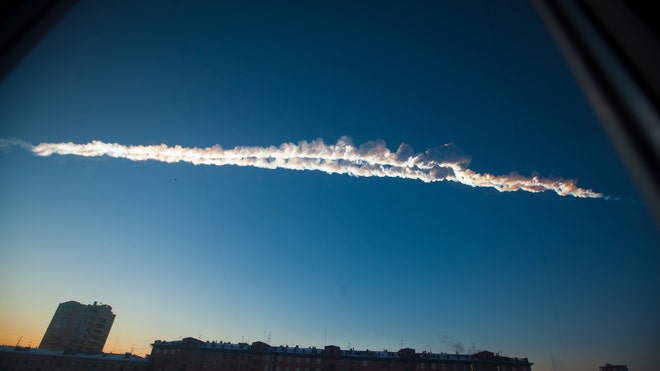
* No, the Russians did not shoot down a UFO, despite some claims. Unfortunately for residents of Chelyabinsk, Russia, it was nothing more than a huge rock from space; a meteor/bolide which it happened to fall to earth only hours before asteroid 2012 DA14 made it's 17,200 mile pass (closer than many satellites)!
At the time of this posting, approximately 1200 people have been injured, in and around Chelyabinsk, mostly by flying glass. Many people may have been injured after having been knocked off their feet by the blast from the fireball.
According to the trajectory of the Chelyabinsk bolide, it had nothing to do with asteroid 1012 DA14... and it wasn't a UFO. -SW
* * *
Press Release: NASA Experts Discuss Russia Meteor in Media Teleconference Today
WASHINGTON
-- NASA experts will hold a teleconference for news media at 4 p.m. EST
today to discuss a meteor that streaked through the skies over Russia's
Urals region this morning.
Scientists have determined the
Russia meteor is not related to asteroid 2012 DA14 that will safely pass
Earth today at a distance of more than 17,000 miles. Early assessments
of the Russia meteor indicate it was about one-third the size of 2012
DA14 and traveling in a different direction.
Panelists for the teleconference are: -- Bill Cooke, lead for the Meteoroid Environments Office at NASA's Marshall Space Flight Center in Huntsville, Ala.
-- Paul Chodas, research scientist in the Near Earth Object Program
Office at NASA's Jet Propulsion Laboratory in Pasadena, Calif.
News media interested in participating should dial 888-843-7186 and use the passcode METEOR.
The teleconference will be carried live online at:
A meteor streaked across the sky and exploded over Russia's Ural Mountains with the power of an atomic bomb Friday, its sonic blasts shattering countless windows and injuring about 1,100 people.
The spectacle deeply frightened many Russians, with some elderly women declaring that the world was coming to an end. Many of the injured were cut by flying glass as they flocked to windows, curious about what had produced such a blinding flash of light.
The meteor -- estimated to be about 10 tons and 49 feet wide -- entered the Earth's atmosphere at a hypersonic speed of at least 33,000 mph and shattered into pieces about 18-32 miles above the ground, the Russian Academy of Sciences said in a statement. But even small asteroids pack a tremendous punch, explained Andrew Cheng of the Johns Hopkins Applied Physics Laboratory.
"It doesn’t take a very large object. A 10-meter size object already packs the same energy as a nuclear bomb," Cheng, who led a 2000-2001 mission for NASA to orbit and land on an asteroid, told FoxNews.com.
Amateur video showed an object speeding across the sky about 9:20 a.m. local time, just after sunrise, leaving a thick white contrail and an intense flash.
"There was panic. People had no idea what was happening," said Sergey Hametov, a resident of Chelyabinsk, a city of 1 million about 930 miles east of Moscow.
"We saw a big burst of light, then went outside to see what it was and we heard a really loud, thundering sound," he told The Associated Press by telephone.
The meteor hit less than a day before Asteroid 2012 DA14 is to make the closest recorded pass of an asteroid to the Earth for a rock of its size -- about 17,150 miles. But the European Space Agency said its experts had determined there was no connection -- just cosmic coincidence.
The meteor released several kilotons of energy above the region, the Russian science academy said. According to NASA, it was about 15 meters or 49 feet wide before it hit the atmosphere, about one-third the size of the passing asteroid.
Some meteorite fragments fell in a reservoir outside the town of Chebarkul. The crash left a 26-foot-wide crater in the ice.
The shock wave blew in more than 1 million square feet of glass, according to city officials, who said 3,000 buildings in the city were damaged. At one zinc factory, part of the roof collapsed.
The Interior Ministry said about 1,100 people sought medical care after the shock wave and 48 of them were hospitalized. Most of the injuries were caused by flying glass, officials said.
There was no immediate word on any deaths or anyone struck by space fragments.
NASA statement on Russia meteor: "According to NASA scientists, the trajectory of the Russia meteor was significantly different than the trajectory of the asteroid 2012 DA14, making it a completely unrelated object. Information is still being collected about the Russia meteor and analysis is preliminary at this point. In videos of the meteor, it is seen to pass from left to right in front of the rising sun, which means it was traveling from north to south. Asteroid DA14's trajectory is in the opposite direction, from south to north."
Update: February 15, 2013 7pm PST
New information provided by a worldwide network of sensors has allowed scientists to refine their estimates for the size of the object that entered that atmosphere and disintegrated in the skies over Chelyabinsk, Russia, at 7:20:26 p.m. PST, or 10:20:26 p.m. EST on Feb. 14 (3:20:26 UTC on Feb. 15).
The estimated size of the object, prior to entering Earth's atmosphere, has been revised upward from 49 feet (15 meters) to 55 feet (17 meters), and its estimated mass has increased from 7,000 to 10,000 tons. Also, the estimate for energy released during the event has increased by 30 kilotons to nearly 500 kilotons of energy released. These new estimates were generated using new data that had been collected by five additional infrasound stations located around the world – the first recording of the event being in Alaska, over 6,500 kilometers away from Chelyabinsk. The infrasound data indicates that the event, from atmospheric entry to the meteor's airborne disintegration took 32.5 seconds. The calculations using the infrasound data were performed by Peter Brown at the University of Western Ontario, Canada.
"We would expect an event of this magnitude to occur once every 100 years on average," said Paul Chodas of NASA's Near-Earth Object Program Office at the Jet Propulsion Laboratory in Pasadena, Calif. "When you have a fireball of this size we would expect a large number of meteorites to reach the surface and in this case there were probably some large ones."
The trajectory of the Russia meteor was significantly different than the trajectory of the asteroid 2012 DA14, which hours later made its flyby of Earth, making it a completely unrelated object. The Russia meteor is the largest reported since 1908, when a meteor hit Tunguska, Siberia. _________________________________________________________
Preliminary information indicates that a meteor in Chelyabinsk, Russia, is not related to asteroid 2012 DA14, which is flying by Earth safely today.
The Russia meteor is the largest reported since 1908, when a meteor hit Tunguska, Siberia. The meteor entered the atmosphere at about 40,000 mph (18 kilometers per second). The impact time was 7:20:26 p.m. PST, or 10:20:26 p.m. EST on Feb. 14 (3:20:26 UTC on Feb. 15), and the energy released by the impact was in the hundreds of kilotons.
Based on the duration of the event, it was a very shallow entry. It was larger than the meteor over Indonesia on Oct. 8, 2009. Measurements are still coming in, and a more precise measure of the energy may be available later. The size of the object before hitting the atmosphere was about 49 feet (15 meters) and had a mass of about 7,000 tons.
The meteor, which was about one-third the diameter of asteroid 2012 DA14, was brighter than the sun. Its trail was visible for about 30 seconds, so it was a grazing impact through the atmosphere.
It is important to note that this estimate is preliminary, and may be revised as more data is obtained.
NASA's Martian Rover Curiosity's photo of strange metal object.
Metal object enlarged and enhanced.
*
The Martian rover Curiosity has discovered a shiny piece of dark metal, found protruding from a rocky area on the red planet's surface. The photo certainly peaked 'my curiosity', so I decided to enlarge and enhance the object in the image provided by NASA.
If you will notice in the full image, there appears to be tire marks, one of which shows up very well. At first glance, I had figured out what that shiny piece of metal is! Any biker can tell by the clues in the photo, that it's a part that fell off of a Harley Davidson motorcycle! A foot-peg.
Seriously, what has NASA spent billions, perhaps trillions of dollars on Mars missions, if they don't plan to investigate something like a piece of metal found in a rock-strewn Martian landscape? "Oh yeah, a piece of metal. Whoopee. Probably just a chunk of meteor, or metal ore that happens to look like a door handle. Rocks are so much more interesting." Not!
Just where is the curiosity in the Curiosity science team? Hold on, it's coming to me... "ignore the obvious." It's an unusual piece of flotsam in a sea of dirt and rock, nothing more. Gotcha! Carry on. -Sunny Williams *
Slashgear.com- The Curiosity rover on Mars has been keeping itself quite busy lately, most recently boring into Mars’ red surface in order to find signs of life. However, in its downtime, the rover likes to take a lot of photos, including self-portraits, but this time around, Curiosity came across a strange chunk of metal sticking out of the ground? What could it be?
The photo was snapped on January 30 using one of the rover’s MastCam cameras to get shots of the landscape, and it ended up getting this odd piece of metal in the frame. NASA’s scientists aren’t 100% sure what it is, but they think it may be a chunk from a meteorite, or possibly a chunk of ore that became exposed by some sort of erosion.
It’s said that the object is only a half-centimeter tall, so it’s extremely tiny compared to how big it looks in the image. NASA hasn’t said whether or not it will check out the piece of metal, or if they’ll just ignore it and continue on with their planned experiments. After all, they do have more holes to drill.
However, while some think it’s simply a tiny piece of metal, Elisabetta Bonora of Alive Universe Images, mentions that the hunk of metal takes up about 35 pixels in the image. Taking into account the camera’s resolution and the distance between the rover and the object, the size of the chunk of metal may actually be larger than just 0.5 cm — it’s possible that it’s up to a foot tall. At this point, we’ll never know, unless NASA decides to investigate, but it’s very possible they just might let it be and continue on as scheduled.
NASA scientists say Voyager 1 could enter interstellar space anywhere from months to a couple of years from now
NASA's Voyager 1 is traveling through the last leg of its journey before entering interstellar space.
Voyager 1, which was launched into space in 1977 to eventually explore interstellar space and become the most distant human-made object, has reached a region that NASA scientists are calling a magnetic highway. This highway consists of charged particles where the sun's magnetic field lines are connected to interstellar magnetic field lines.
This area is still considered part of our heliosphere, which is a bubble of charged particles around the sun, because the direction of the magnetic field lines has not changed. The direction of these lines will change when Voyager 1 enters interstellar space, and scientists believe the magnetic highway is the last stretch before finally making it to interstellar space.
"Although Voyager 1 still is inside the sun's environment, we now can taste what it's like on the outside because the particles are zipping in and out on this magnetic highway," said Edward Stone, Voyager project scientist based at the California Institute of Technology, Pasadena. "We believe this is the last leg of our journey to interstellar space. Our best guess is it's likely just a few months to a couple years away. The new region isn't what we expected, but we've come to expect the unexpected from Voyager."
What will our little 'messenger of peace' find out there, in the vastness of space between star systems? For good or ill, Voyager treks on in search of other worlds, other solar systems.
What might it find?
I am reminded of "Star Trek - The Movie", where a massive ship approaches Earth, seeking it's creator. If it doesn't find "the creator", "V'ger" will destroy planet Earth.
The crew of the Enterprise finally deduce that V'ger is actually "Voyager 6". While in deep interstellar space, Voyager 6 is found by a superior race of (probably) cybernetic aliens, who repair the tiny craft, place it at the core of a massive ship, pat it's little metal bottom and send it home to daddy. The mission: Join with the creator, or destroy.
Oh my!
Lucky for us, there never was a Voyager 6. NASA only sent two Voyagers into space.
The thought still remains. Let's just hope we never have to live out that scenario with V-1, or V-2. The real Captain Kirk and Mr. Spock might not be so clever, as in the movies. -Sunny Williams/LITS
I've received numerous emails from people all over, who think they may have seen a satellite in orbit. Well, what is a satellite? A satellite is an object that orbits (revolves) around another object. Our moon is a natural satellite. Objects put into orbit around our planet (and others) by human endeavors, are called artificial satellites.
Some satellites can be see with the naked eye, by observers on the ground. These are generally low earth orbit (LEO) satellites, while other satellites orbit too far out from our planet to be visible without a powerful telescope.
With today's technology, anyone can track most of the satellites in orbit around Earth. For those of you attached to your mobile phones, there's an app for that.
Meanwhile, here is some useful information on satellites, which I hope will increase your star-gazing pleasure. -SW
Geostationary Orbit (GEO) These satellites are in orbit above the Earth's equator. They stay above the same location on Earth. They are used for telecommunications, television transmission and for navigation.
Low Earth orbit (LEO) A satellite has a Low Earth Orbit when it orbits somewhere between 300 and 800 km above the Earth's surface. These satellites only take about 90 minutes to go around the Earth. They are ideal for making observations of the Earth's resources.
Polar Orbits A polar orbit is a special LEO in which a satellite travels north-south over the Earth's poles, rather than in the more usual east-west direction. Polar orbits can be used to map the complete Earth once a day. This is needed for weather forecasts.
Global Positioning System (GPS) satellites This is a fleet of satellites which allows us to know exactly where on Earth we are.
Last night I watched "THE KILLSHOT: APPROACHING THE MOMENT", on DVD. According to Major Ed Dames (ret.), remote viewers have seen a doomsday scenario, in which the Earth will be devastated by a tremendous solar flare. It isn't that far fetched, as signs keep pointing to that most real possibility.
On Tuesday, August 6, 2011, an x6.9 flare was recorded. Then on Monday, October 22, 2012, NASA's Solar Dynamics Observatory (SDO) captured the sun erupting with an X1.8 class solar flare. The solar flare came from an active region on the left side of the sun known as AR 1598. This area of the sun has been known as a source of weaker flares.
So the October 22, 2012 flare was weaker than the one on August 6, 2011. Does that mean the sun's flare activity is winding down? No, NASA predictes 2013 (May) will see solar storms building towards a peak, though at the same time, they claim that killer solar storms are an impossibility. Gee, that still doesn't sound very reassuring.
So just what are solar flares? Flares occur when powerful magnetic fields in and around the sun reconnect. Often associated with active regions on the sun's surface, where the magnetic fields are strongest and seen as sun spots.
Classified according to their strength, the smallest flares are B-class, followed by C, M and X, which is the largest.
Each letter represents a ten-fold increase in energy output. Therefore, an X is 10 times an M and 100 times a C.
There is also another scale within each letter class, these range from 1 to 9.
C-class flares have little noticeable affect on Earth but M-class flares can cause brief radio blackouts at the North and South poles and produce minor radiation storms which could endanger astronauts.
X is the last letter and most powerful class, however, there are flares 10 times more powerful than an X1 and X-class flares can go higher than 9.
In 2003, a very powerful flare was recorded (during the last solar maximum). That particularly powerful flare overloaded the sensors that were measuring it (the sensors cut-out at X28). A powerful X-class flare such as that can create long lasting radiation storms, harm satellites, create global transmission problems, cause world-wide blackouts and even airline passengers flying near the poles, could receive small doses of radiation.
On the cloudless British morning of Thursday, September 1, 1859, solar astronomer Richard Carrington took note of and drew a representation, of the sunspots he saw through the projected image from his 11 inch wide telescope. Before dawn the next day, skies all over the Earth erupted in red, purple and green auroras, which were so brilliant, that newspapers could be read as if it were daylight. Auroras could even be seen as far south as Cuba, Jamaica, the Bahamas, El Salvador and even in Hawaii.
That wasn't the end of the story for the "Carrington Flare." Telegraph systems worldwide, went haywire. Sparks discharged, shocking telegraph operators, even setting fire to telegraph paper. Not only that, when telegraphers disconnected the batteries powering the telegraph lines, the aurora-induced electric currents in the wires still allowed messages to be transmitted, though many messages were gibberish.
So what would happen if a flare like the 1859 flare occurred? Or how about that mega-flare that Major Ed Dames' remote viewers have seen in our near future?
Power grids all over the world would go down and all electronic communications would cease. Satellites would be fried. The International Space Station would be no protection for the astronauts and airplanes could conceivably fall from the sky. There would be no phones, no TV, no Internet and no microwave ovens. And if you were out in it, you'd probably have a really nasty sunburn and a huge dose of radiation. Bummer!
Society would most likely be knocked back to (at least temporarily), that day in 1859, minus the telegraph. Such circumstances could last anywhere from a few months, to years! That wouldn't be so bad now, would it? Well, maybe so. I've finally gotten used to "texting".
-Sunny Williams
[Author's Note: Though I do find this subject to be very serious and know that such a mega solar event could possibly kill millions, if not billions of people, humor is my preferred choice of self defense (instead of uncontrollable sobbing).]
A team of alien-hunting astroboffins has been awarded a grant to
search the sky for immense engineering feats that would reveal the
existence of astral civilizations far, far more advanced than us puny
humans.
Lead by assistant professor Jason Wright of Penn State's Department of Astronomy & Astrophysics, the team will use NASA's Wide-field Infrared Survey Explorer (WISE) to search the sky for the infrared fingerprints of possible Dyson Spheres, energy-capturing mega-structures named after all-around smart guy Freeman Dyson, who postulated their existence in a 1960 paper.
According to Dyson, any advanced civilization would inevitably use up
all of the resources on their planet, and would be forced to look
elsewhere for energy. The most obvious place, he surmised, would be the
star around which their planet orbits.
To capture that energy, they would construct the aforementioned
Spheres – mind-bogglingly immense structures that would surround the
star and collect its energy. These structures could be actual spheres,
but more likely would take the form of rings, swarms, or banded
spherical collections of energy harvesters.
No matter what form they might take, they'd undoubtedly give off
infrared radiation that could be detected by such sensitive sensors such
as those aboard WISE – and that's where Wright and his team come in. The Atlantic reports that Wright has been awarded funding from the John Templeton Foundation to conduct his search, in response to his proposal, "Constraining the Abundance of Kardashev Type II and III Civilizations From Large Area Infrared Surveys".
We'll get back to Kardashev's civilization types in a moment.
View from the International Space Station of the SpaceX Dragon spacecraft as the station's robotic arm moves Dragon into place for attachment to the station. May 25, 2012. Photo: NASA; Courtesy SpaceX.com.
Press Release-
SPACEX, NASA TARGET OCT. 7 LAUNCH FOR FIRST CONTRACTED U.S. CARGO RESUPPLY MISSION TO SPACE STATION
HOUSTON -- NASA managers, Space Exploration Technologies Corp. (SpaceX) officials and international partner representatives Thursday announced Sunday, Oct. 7, as the target launch date for the first contracted cargo resupply flight to the International Space Station under NASA's Commercial Resupply Services (CRS) contract.
International Space Station Program managers confirmed the status and readiness of the Falcon 9 rocket and its Dragon cargo spacecraft for the SpaceX CRS-1 mission, as well as the space station's readiness to receive Dragon.
Launch is scheduled for 8:34 p.m. EDT from Space Launch Complex 40 at Cape Canaveral Air Force Station in Florida. A back up launch opportunity is available on Oct. 8.
Media accreditation to view the launch now is open. International media without U.S. citizenship must apply for credentials to cover the prelaunch and launch activities by Wednesday, Sept 26. For U.S. media, the deadline to apply is Wednesday, Oct. 3.
Questions about accreditation may be directed to the Public Affairs Office at NASA's Kennedy Space Center at 321-867-2468. All media accreditation requests must be submitted online at: https://media.ksc.nasa.gov
The launch of the Dragon spacecraft will be the first of 12 contracted flights by SpaceX to resupply the space station and marks the second trip by a Dragon to the station, following a successful demonstration mission in May. SpaceX services under the CRS contract will restore an American capability to deliver and return significant amounts of cargo, including science experiments, to the orbiting laboratory -- a feat not achievable since the retirement of the space shuttle.
The Dragon will be filled with about 1,000 pounds of supplies. This includes critical materials to support the 166 investigations planned for the station's Expedition 33 crew, including 63 new investigations. The Dragon will return about 734 pounds of scientific materials, including results from human research, biotechnology, materials and educational experiments, as well as about 504 pounds of space station hardware.
Materials being launched on Dragon will support experiments in plant cell biology, human biotechnology and various materials technology demonstrations, among others. One experiment, called Micro 6, will examine the effects of microgravity on the opportunistic yeast Candida albicans, which is present on all humans. Another experiment, called Resist Tubule, will evaluate how microgravity affects the growth of cell walls in a plant called Arabidopsis. About 50 percent of the energy expended by terrestrial-bound plants is dedicated to structural support to overcome gravity. Understanding how the genes that control this energy expenditure operate in microgravity could have implications for future genetically modified plants and food supply. Both Micro 6 and Resist Tubule will return with the Dragon at the end of its mission.
Expedition 33 Commander Sunita Williams of NASA and Aki Hoshide of the Japan Aerospace Exploration Agency will use a robot arm to grapple the Dragon following its rendezvous with the station on Wednesday, Oct. 10. They will attach the Dragon to the Earth-facing port of the station's Harmony module for a few weeks while crew members unload cargo and load experiment samples for return to Earth.
Dragon is scheduled to return in late October for a parachute-assisted splashdown in the Pacific Ocean off the coast of southern California.
While NASA works with U.S. industry partners to develop commercial spaceflight capabilities, the agency also is developing the Orion spacecraft and the Space Launch System (SLS), a crew capsule and heavy-lift rocket to provide an entirely new capability for human exploration. Designed to be flexible for launching spacecraft for crew and cargo missions, SLS and Orion will expand human presence beyond low Earth orbit and enable new missions of exploration across the solar system.
For information about the International Space Station, research in low Earth orbit, NASA's commercial space programs and the future of American spaceflight, visit: http://www.nasa.gov/exploration
For NASA TV downlink, schedule and streaming video information, visit: http://www.nasa.gov/ntv
SpaceX designs, manufactures and launches the world's most advanced rockets and spacecraft. With a diverse manifest of more than 40 launches to resupply the space station and deliver commercial and government satellites to orbit, SpaceX is the world's fastest growing launch services provider. In 2012, SpaceX made history when its Dragon spacecraft became the first commercial vehicle to successfully attach to the International Space Station -- a feat previously achieved by only four governments. With the retirement of the Space Shuttle, the SpaceX Falcon 9 rocket and Dragon spacecraft are carrying cargo, and one day will carry astronauts, to and from the space station for NASA. Founded in 2002 by Elon Musk, SpaceX is a private company owned by management and employees, with minority investments from Founders Fund, Draper Fisher Jurvetson, and Valor Equity Partners. The company has more than 1,800 employees in California, Texas, Florida and Washington, DC. For more information, visit SpaceX.com.
NASA's Shuttle Endeavour has arrived safely at the Los Angeles International Airport and will soon be displayed at it's new home, at the California Science Center's Samuel Oschin display pavilion. There have been thousands of photo opts on it's final trek, however, this is one photo of Endeavour that you might not have seen.
On May 23, 2011, Expedition 27 Commander Dmitry Kondratyev and Flight Engineers Cady Coleman and Paolo Nespoli un-docked from the International Space Station, heading home aboard the Russian Soyuz TMA-20. That was the perfect time to take video and photos of a sight we've never had a real chance to see, a shuttle (Endeavour) docked to the orbital complex.
An observer in Killeen, Texas reported to MUFON of having witnessed a light traveling across the sky on September 9, 2012, early morning.
This report is as is, with no corrections.
MUFON Case # 42539
Date of Sighting: 09/09/2012
Time of Sighting: 06:47 a.m.
Location: Killeen, Texas
Sighting Duration: 00:01:00
Object Flight Path: Straight-line path
Object Shape: Oval
Summary: Solid Oval Light
Report:
As I was watching the weather report and gathering the trash in the house (as it was trash day) I was about to leave for work. So I went outside to take the trashcan to the street. I had been monitoring the phases of the moon for the past few mornings just because, and noticed the position of Venus. As I was heading in the house to get my things to go to work, I was glancing up curious about the direction of cloud movement because i had noticed for a brief moment it seemed that the clouds were moving due to a light in the sky , which I figured was a star. So I looked straight up and thought the clouds were moving fairly quickly but wasn't sure how fast. So I stuck my thumb up in the air to make a non-moveable reference point to see how fast they were moving and noticed it wasn't the clouds moving at all. It was the light I had seen briefly that I thought was just a star. But upon a closer look it was brighter than the star and even the planet Venus. I ran inside as quickly as possible to get my Ipad as it was the nearest camera accessible camera at the time and started filming. I didn't hear any sound or see any beacon lights (red) as I normally do when I see a plane. I live by the airport and hear and see planes, of all types, all the time. Especially when its dark, during one of my sky observation times. I didn't notice anything else as I was filming and was trying to make sense of what it COULD be. After the experience, I went to work and shared the video with a few others. One thing I did notice tonight, as I am sitting here typing and reviewing the video, is that the sky seems to be brighter than it actually appeared outside this morning. I don't know if that is due to the camera capturing more light than the human eye sees or what. I also noticed a blinking light at the beginning of the video that I didn't notice when I started to actually record the footage or when I was sharing the video with coworkers. The light started in the south to southwest and moved in a straight path to the north, northeast. Once again, I didn't notice any sound. I'm still not sure what it was, but I think its worth sharing. My feelings about seeing this was one of excitement and nervousness.
[No video was provided.]
*
Editor's Note: Could this have been simply a sighting of the International Space Station (ISS), or was it something else?
When you observe a bright light traveling across the sky, one possible way to identify it, or to rule it out, is to check with NASA:
PHOTO CREDIT: NASA/JPL-Caltech/Cornell Univ./ USGS/Modesto Junior College and Space.com
Strange Mystery Spheres on Mars Baffle Scientists
Space.com- A strange picture of odd, spherical rock formations on Mars from NASA's Opportunity rover has scientists scratching their heads over what exactly they're looking at.
The new Mars photo by Opportunity shows a close-up of a rock outcrop called Kirkwood covered in blister-like bumps that mission scientists can't yet explain. At first blush, the formations appear similar to so-called Martian "blueberries" — iron-rich spherical formations first seen by Opportunity in 2004 — but they actually differ in several key ways, scientist said.
"This is one of the most extraordinary pictures from the whole mission," said rover mission principal investigator Steve Squyres of Cornell University in Ithaca, N.Y., in a statement. "Kirkwood is chock full of a dense accumulation of these small spherical objects. Of course, we immediately thought of the blueberries, but this is something different. We never have seen such a dense accumulation of spherules in a rock outcrop on Mars."
(CBS News) Neil Armstrong, the Apollo 11 astronaut who became the first human being to set foot on another world, has died. He was 82.
In a statement his family said Armstrong had passed away following complications resulting from cardiovascular procedures.
The family described him as a loving husband, father, grandfather, brother and friend, and also as "a reluctant American hero who always believed he was just doing his job."
That's one small step for (a) man, one giant leap for mankind.
When Armstrong set foot on the moon on July 20, 1969, he fulfilled the goal that had been set by President John F. Kennedy just eight years earlier.
It was a long, long way from Armstrong's birthplace near tiny Wapakoneta, Ohio in 1930.
For many years, Titan's thick, methane- and nitrogen-rich atmosphere kept astronomers from seeing what lies beneath. Saturn's largest moon appeared through telescopes as a hazy orange orb, in contrast to other heavily cratered moons in the solar system.
In 2004, the Cassini-Huygens spacecraft — a probe that flies by Titan as it orbits Saturn — penetrated Titan's haze, providing scientists with their first detailed images of the surface. Radar images revealed an icy terrain carved out over millions of years by rivers of liquid methane, similar to how rivers of water have etched into Earth's rocky continents.
While images of Titan have revealed its present landscape, very little is known about its geologic past. Now researchers at MIT and the University of Tennessee at Knoxville have analyzed images of Titan's river networks and determined that in some regions, rivers have created surprisingly little erosion. The researchers say there are two possible explanations: either erosion on Titan is extremely slow, or some other recent phenomena may have wiped out older riverbeds and landforms.
I received an email from a witness, who saw flashes of light near the International Space Station; lights that appeared to be further out in space. Here is that email.
Lights around ISS
Levelland, Texas 6/25/2012 10:23 pm (22:23)
I was watching the space station fly over since it was a clear night and as it passed over a light flashed 2 times immediately behind the space station. It was a brilliant white light with a blueish tint. A few seconds later it flashed a third time in the exact same spot as the first 2 flashes. I was on the phone with my wife who was 20 miles away and she seen them also. The lights appeared to come from farther out in space than the space station.
If anyone else witnessed this event, please contact me. Thank you. - Sunny
Well, it may not be a rocket to the moon, as it doesn't even quite reach "space". However, if you put on your headphones and enlarge the video to full screen, you'll see what it looks and sounds like to have a rocket strapped to your butt, then launched to 28 miles above the earth.
In this video, Riding the Booster Up and Down In 400 Seconds, you'll not only see the ride from the perspective of the camera but you will hear ever clank, bang, boom, rattle and whoosh, as the boosters propell the space shuttle away from earth, release, then fall back to earth for a splashdown in the Atlantic.
NASA's booster rocket video is dazzling in detail. And with the sound works done by Skywalker Studios, it's an amazing armchair ride to the far reaches of our atmosphere, that should not be missed.
This spectacular footage will be an extra on a new NASA DVD, which will commemorate the Space Shuttles.
Big Kudos to NASA for this stunning piece of film and to Skywalker Sound, for giving us a video ride into a realm where so few humans have been.
This video was compiled using footage obtained from booster cameras aboard shuttle flights STS-117 and STS 127.
Velocities shown are approximations taken from actual flight data.
Sound Design & Mixing by Benny Burtt and Noah Katz.
Post-Production Sound Services by Skywalker Sound, a Lucasfilm Ltd. Company, Marin County, California.
*
From the upcoming Special Edition Ascent: Commemorating Space Shuttle DVD/BluRay a movie from the point of view of the Solid Rocket Booster with sound mixing and enhancement done by the folks at Skywalker Sound.
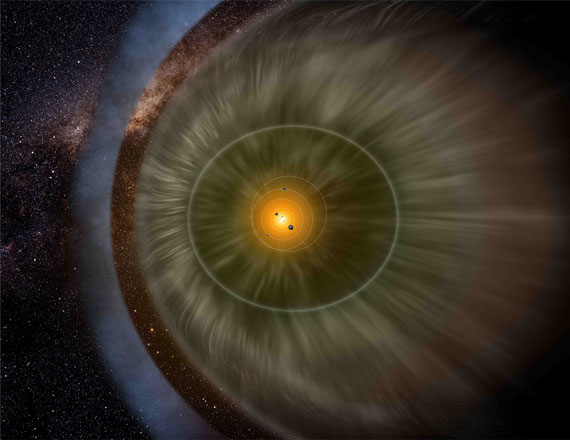
An artist’s rendition of a portion of our heliosphere, with the solar wind streaming out past the planets and forming a boundary as it interacts with the material between the stars.
Image Credit: Adler Planetarium/IBEX team.
*
Interstellar Boundary Exolorer (IBEX)
January 31, 2012
From Dave McComas, IBEX Principal Investigator:
Back in October 2009, we announced IBEX’s first major science results, including the observation of what has become known as the "IBEX Ribbon." Since that time, IBEX has been detecting energetic neutral atoms coming from the boundary of our Solar System and from regions of our Earth’s magnetosphere, and we have periodically updated the IBEX website with information on these topics.
In those first 2009 science results, we also announced the first–ever direct observations of neutral hydrogen and oxygen atoms drifting in from the interstellar medium, outside our heliosphere. Our talented science team has continued to make observations of these – and other – interstellar neutrals, and we are proud to showcase their work, published as a set of six papers in the February issue of Astrophysical Journal Supplements as a special section titled "IBEX Direct Observations of Interstellar Neutrals." I hope you will enjoy learning more about this fascinating aspect of IBEX’s exquisite capabilities, which are even allowing us to probe the local region outside our heliosphere. Congratulations to the members of the science team who worked hard on these amazing results – and GO IBEX!
What has IBEX detected?
IBEX has measured hydrogen, oxygen, neon, and helium atoms drifting in from outside our heliosphere toward Earth’s region of our Solar System. Atoms such as these are called "interstellar neutral atoms" or "ISNs." Prior to IBEX the only other spacecraft to detect ISNs was Ulysses, over a decade ago, and it could only measure neutral interstellar helium. IBEX’s measurements of interstellar hydrogen, oxygen, and neon are the first–ever detections of these atoms by any spacecraft. The IBEX–Lo instrument on IBEX detects all of these ISNs.
How do we know these ISNs are from outside our heliosphere?
Our Sun emits a "wind" of material outward, at an average of a million miles (1.6 million kilometers) per hour. As the solar wind streams away from the Sun, it races out toward the space between the stars. We think of this space as "empty" but it contains traces of gas, dust, and charged, or "ionized," gas – together called the "interstellar medium." The solar wind blows against this material and clears out a cavity–like region in the ionized gas. This cavity is called our "heliosphere."
Filmed aboard the International Space Station, Richard Garriott's eight-minute science fiction movie "Apogee of Fear", has yet to be released by NASA. Why? It's goofy, it's whacky and it shows that the astronauts on the ISS can have fun too, or are bored and have too much time on their hands?
Well, I did laugh. Even more so at NASA for being such tight a$$es (and they plan to edit). After all, if they'd release it now, you wouldn't have to watch (like I did), this poor quality cam vid by Dragon Con.