************************************************

Showing posts with label Nasa Videos. Show all posts
Showing posts with label Nasa Videos. Show all posts
Sunday, May 1, 2016
Aliens Exist On The Moon - 2015 Documentary Video
*
************************************************
************************************************


Why we never returned to the Moon... or did we? Video
*
Were we warned off the moon? Were we warned not to return?
********************************************
Were we warned off the moon? Were we warned not to return?
********************************************
Sunday, February 24, 2013
NASA Video: Loops of Plasma Rain Down On The Sun
Be it heavenly or hellish, our Sun is definitely beautiful!
Video Link
Eruptive events on the sun can be wildly different. Some come just with a solar flare, some with an additional ejection of solar material called a coronal mass ejection (CME), and some with complex moving structures in association with changes in magnetic field lines that loop up into the sun's atmosphere, the corona.
On July 19, 2012, an eruption occurred on the sun that produced all three. A moderately powerful solar flare exploded on the sun's lower right hand limb, sending out light and radiation. Next came a CME, which shot off to the right out into space. And then, the sun treated viewers to one of its dazzling magnetic displays -- a phenomenon known as coronal rain.
Read more here.
********************************************************
Monday, September 24, 2012
A photo of the shuttle, one you may not have seen
 |
| Image credit: Paulo Nespoli/NASA/Discovery News |
NASA's Shuttle Endeavour has arrived safely at the Los Angeles International Airport and will soon be displayed at it's new home, at the California Science Center's Samuel Oschin display pavilion. There have been thousands of photo opts on it's final trek, however, this is one photo of Endeavour that you might not have seen.
On May 23, 2011, Expedition 27 Commander Dmitry Kondratyev and Flight Engineers Cady Coleman and Paolo Nespoli un-docked from the International Space Station, heading home aboard the Russian Soyuz TMA-20. That was the perfect time to take video and photos of a sight we've never had a real chance to see, a shuttle (Endeavour) docked to the orbital complex.
See (NASA) video here.
See more photos and story here.
To all the shuttle pilots and crew; to Mission Control and all involved, good job and thanks for the memories. "Roger, out."
- SW
**************************************************
Wednesday, September 21, 2011
The sky is falling! No wait, that's a satellite...
Y'all better duck now, ya hear?
Huge Defunct Satellite Falling to Earth Faster Than Expected, NASA Says
 |
| An artist's concept of the Upper Atmosphere Research Satellite (UARS) satellite in space. The 6 1/2-ton satellite was deployed from space shuttle Discovery in 1991 and decommissioned in December 2005. CREDIT: NASA |
Space.com- NASA space junk experts have refined the forecast for the anticipated death plunge of a giant satellite, with the U.S. space agency now predicting the 6 1/2-ton climate probe will plummet to Earth around Sept. 23, a day earlier than previously reported.
The defunct bus-size spacecraft is NASA's Upper Atmospheric Research Satellite (UARS), which launched in 1991 and was shut down in 2005 after completing its mission. The satellite was expected to fall to Earth sometime this year, with experts initially pegging a weeks-long window between late September and early October, then narrowing it to the last week of this month.
That window, NASA now says, has been trimmed to just three days.
"Re-entry is expected Sept. 23, plus or minus a day. The re-entry of UARS is advancing because of a sharp increase in solar activity since the beginning of this week," NASA officials wrote in a status update today (Sept. 16). The projection is a day earlier than a previous forecast released by NASA yesterday.
NASA spokeswoman Beth Dickey confirmed with SPACE.com earlier today that the reason UARS is expected to fall early in its re-entry window is because of the sharp uptick in solar activity. Solar effects from the sun can create an extra drag on satellites in space because they can heat the Earth's atmosphere, causing it to expand, agency officials have said. [Photos: Space Debris & Cleanup Concepts]
Where will UARS fall?
But exactly where the UARS spacecraft will fall is still unknown.
NASA expects at least 26 large pieces of the massive satellite to survive the scorching temperatures of re-entry and reach Earth's surface. Titanium pieces and onboard tanks could be among that debris, but the UARS satellite carries no toxic propellant (NASA used up all the fuel in 2005).
The debris is expected to fall over a swath of Earth about 500 miles (804 kilometers) long, NASA officials said. [Video: Where Could UARS Satellite Debris Fall?]
There is a 1-in-3,200 chance of satellite debris hitting a person on the ground, odds that NASA says are extremely remote. Outside experts agree.
"Look at how much of Earth is covered with water," Victoria Samson, the Washington Office Director of the Secure World Foundation, an organization dedicated to the peaceful use of outer space, told SPACE.com this week. "There's a really good chance it's going to go straight into the ocean."
Constant satellite watch
NASA officials expect the UARS satellite to fall over a region somewhere between the latitudes of northern Canada and southern South America, which leaves a vast swath of the world open as a possible re-entry point. About 75 percent of the Earth's surface is covered in water, which makes an ocean splashdown likely, NASA and experts have said.
NASA and the Joint Space Operations Center of U.S. Strategic Command at Vandenberg Air Force Base, Calif., are keeping a close watch on the falling satellite, but will only be able to pinpoint its actual crash zone to within about 6,000 miles (10,000 km) about two hours before re-entry.
As of Thursday, the UARS satellite was flying in an orbit of between 143 and 158 miles (230 to 255 km) above Earth. That orbit is dropping lower each day, NASA officials said. [Infographic: NASA's Falling UARS Satellite Explained]
NASA has advised the public not to touch any debris that may reach the surface, should it be discovered. Instead, the space agency says that anyone who finds satellite debris should contact their local law enforcement agency.
The $750 million UARS mission was designed to measure ozone and other chemical compounds found in Earth's ozone layer in order to better understand how the upper atmosphere affects our planet. It also recorded wind speeds and temperatures in the stratosphere, as well as the energy Earth received from the sun.
To follow NASA's UARS satellite updates, click here.
This report was updated to reflect new estimates of the UARS re-entry released by NASA after this story first appeared.
Read more of the story, photos and videos.
Editor's Note: See the latest on the UARS satellite re-entry as of Sept. 19 here - NASA: Huge Defunct Satellite Will Fall to Earth This Week
**********************************************
Tuesday, August 30, 2011
NASA NEWS and Commentary
 |
| A Russian Soyuz rocket launches the unmanned Progress 44 cargo ship from Baikonur Cosmodrome on Aug. 24, 2011 to deliver fresh supplies to the International Space Station. The rocket and spacecraft crashed in eastern Russian just over five minutes after liftoff. CREDIT: RSC Energia |
Space Station Crew Closely Watching Russian Rocket Crash Investigation
Space.com- Astronauts on the International Space Station are keeping a close eye on the investigation into the recent crash of a Russian rocket in order to learn how it will impact their mission in orbit.
The Soyuz rocket was carrying Russia's Progress 44 supply ship for the International Space Station, which was expected to deliver 3 tons of supplies to the orbiting lab's six-man crew. Instead, the rocket and cargo ship crashed in eastern Russia after a malfunction in the booster's third stage forced an engine shutdown.
"It's a pity the launch of Progress resupply vehicle didn't go well. Experts have worked on the investigation of its various impacts," station astronaut Satoshi Furukawa of Japan wrote on Aug. 26, two days after the crash, on Twitter, where he posts updates about his mission as @Astro_Satoshi. "But, as there are plenty of supplies to support the crew, we'll be fine for a while."
Since Russia's Federal Space Agency uses similar versions of its Soyuz rocket design to launch unmanned Progress vehicles and its crewed space capsules, officials want to make sure that they are safe to carry astronauts and cosmonauts. The next Soyuz to ferry a crew to the station was slated to launch Sept. 22 to replace three astronauts who are due to return home on Sept. 8.
Those plans may now change, the astronauts said. It's possible that the launch of the new station crew will be delayed until the crash investigation is complete, and that may force the three returning crewmembers to stay in orbit longer than planned.
"We don't have a lot of decisions made yet because we want to make sure we have the right course of action," station astronaut Ron Garan, of NASA, told SPACE.com from orbit Thursday (Aug. 25). "So we're going to take a little bit of time to think about it and make sure we have all the facts together before we go on and have a game plan." [Video: Station Crew Discusses Rocket Crash with SPACE.com]
Garan is one of the three astronauts who would have to extend their stay on the space station. They were due to land next week to end a six-month spaceflight.
"Up here, we're in kind of a wait-and-see mindset," Garan said. "We're fully prepared to support whatever decisions are made."
NASA will hold a press conference today at 10 a.m. EDT (1400 GMT) with the latest on the crash's impacts on the space station crew.
Russian rocket inquiry
Before the Progress 44 crash, Russia was expected to launch four Soyuz rockets —two carrying new crews and two with unmanned Progress cargo ships — as part of the regular flight schedule.
If the investigation into last week's rocket crash isn't completed quickly, NASA and its space station partners may consider cutting the orbiting lab's crew size in half, from six people to three, or even leaving the space station unmanned for a time until flights can be resumed, station managers have said. Space station flight planners have until October to decide to shift down to a three-person crew, they added.
[Photos: Building the International Space Station]
"If things extend too long, which we don't have any indication today that's the case but given the anomaly we have to be prepared, there is an ability to operate station with less than six crew if that becomes necessary," NASA's space station program manager Mike Suffering told reporters last week just after the rocket crash.
With NASA's space shuttle fleet retired (the final flight was in July), Russia's Soyuz space capsules are the only vehicle currently ferrying astronauts to and from the International Space Station. Robotic cargo ships built by Russia, Japan and the European Space Agency also make deliveries to the orbiting lab.
NASA currently has contracts with two private U.S. spaceflight companies, SpaceX and Orbital Sciences, to provide unmanned cargo deliveries to the station in the next few years. Test flights for those vehicles are expected in the coming months. NASA also plans to eventually use commercial spacecraft for astronaut launches, too.
However, Russia's string of rocket and satellite failures in the last year that has caused some concern among U.S. lawmakers and experts since the country is also the sole avenue for American spaceflight until the new private spaceships become available.
Suffredini said he is confident NASA's Russian partners will find the cause of the Soyuz rocket malfunction and resume flights as soon as it is safe to do so.
"We're trying, right now, to give our Russian colleagues time to collect the data," Suffredini said. "Really, what you need right now is time."
Space station crew size cut ahead?
The space station currently has enough supplies to support a full, six-person for about 50 extra days beyond the scheduled Sept. 8 return of Garan and his crewmates, Suffredini added. There are enough supplies to support a smaller crew through at least March 2012, when the next European space freighter is due at the station, he said.
Suffredini also said that, barring an unforeseen major system or equipment failure, the space station could be even be flown without a crew for up to a year. Such a move, however, would be unprecedented.
The $100 billion space station has been continuously inhabited by crews of various sizes, from two-person skeleton crews to a full complement of six, since the first crew took up residence in 2001. The space station was completed earlier this year after more than a decade of orbital construction. It is larger than a football field and can be easily spotted by observers on Earth at night if they have clear skies and know where to look.
Space station officials are hopeful Russia's Soyuz rocket crash will be solved in time for the next scheduled launch of a Progress cargo ship, which is slated for late October.
On the space station, the astronauts said they, too, are confident that Russia's rocket issues will be solved, and that they are ready for any challenges, be it a decision to extend the current crew's mission or cut the station crew size in half temporarily.
"Obviously, I would have mixed feelings … I mean I've been away from home for a long time. But a lot of people are away from home doing things that they believe in," Garan said, adding that at the very least he'd have more time to share his spaceflight experience with people on Earth. "So there's an upside and a downside and whatever the decision is, I think it will be what's best for the program and we'll fully support it."
Read more here.
* * *
'Suitcase' Nuclear Reactors to Power Mars Colonies
 |
| Image credit: NASA |
Discovery News- Nuclear power is an emotive subject -- particularly in the wake of the Fukushima power plant disaster after Japan's March earthquake and tsunami -- but in space, it may be an essential component of spreading mankind beyond terrestrial shores.
On Monday, at the 242nd National Meeting and Exposition of the American Chemical Society (ACS) in Denver, Colo., the future face of space nuclear power was described. You can forget the huge reactor buildings, cooling towers and hundreds of workers; the first nuclear reactors to be landed on alien worlds to support human settlement will be tiny.
Think less "building sized" and more "suitcase sized."
"People would never recognize the fission power system as a nuclear power reactor," said James E. Werner, lead of the Department of Energy's (DOE) Idaho National Laboratory.
"The reactor itself may be about 1 feet wide by 2 feet high, about the size of a carry-on suitcase. There are no cooling towers. A fission power system is a compact, reliable, safe system that may be critical to the establishment of outposts or habitats on other planets. Fission power technology can be applied on Earth's Moon, on Mars, or wherever NASA sees the need for continuous power."
Tumbleweed WATCH VIDEO: New concepts for Mars-probing rovers would use Martian wind to move around the planet.
Obviously, this will be welcome news to Mars colonization advocates; to have a dependable power source on the Martian surface will be of paramount importance. The habitats will need to have a constant power supply simply to keep the occupants alive. This will be "climate control" on an unprecedented level.
Water extraction, reclamation and recycling; food cultivation and storage; oxygen production and carbon dioxide scrubbing; lighting; hardware, tools and electronics; waste management -- these are a few of the basic systems that will need to be powered from the moment humans set foot on the Red Planet, 24 hours 39 minutes a day (or "sol" -- a Martian day), 669 sols a year.
Fission reactors can provide that.
However, nuclear fission reactors have had a very limited part to play in space exploration up until now. Russia has launched over 30 fission reactors, whereas the US has launched only one. All have been used to power satellites.
Radioisotope thermoelectric generators (RTGs), on the other hand, have played a very important role in the exploration of the solar system since 1961.
These are not fission reactors, which split uranium atoms to produce heat that can then be converted into electricity. RTGs depend on small pellets of the radioisotope plutonium-238 to produce a steady heat as they decay. NASA's Pluto New Horizons and Cassini Solstice missions are equipped with RTGs (not solar arrays) for all their power needs. The Mars Science Laboratory (MSL), to be launched in November 2011, is powered by RTGs for Mars roving day or night.
RTGs are great, but to power a Mars base, fission reactors would be desirable because they deliver more energy. And although solar arrays will undoubtedly have a role to play, fission reactors will be the premier energy source for the immediate future.
"The biggest difference between solar and nuclear reactors is that nuclear reactors can produce power in any environment," said Werner. "Fission power technology doesn't rely on sunlight, making it able to produce large, steady amounts of power at night or in harsh environments like those found on the Moon or Mars. A fission power system on the Moon could generate 40 kilowatts or more of electric power, approximately the same amount of energy needed to power eight houses on Earth."
"The main point is that nuclear power has the ability to provide a power-rich environment to the astronauts or science packages anywhere in our solar system and that this technology is mature, affordable and safe to use."
Of course, to make these "mini-nuclear reactors" a viable option for the first moon and Mars settlements, they'll need to be compact, lightweight and safe. Werner contends that once the technology is validated, we'll have one of the most versatile and affordable power resources to support manned exploration of the solar system.
Sadly, I suspect the biggest hurdle facing space fission power won't be the viability of its technology, but the bad press nuclear power receives, on Earth and in space.
Read more here.
************************************************
Saturday, July 9, 2011
Videos: 8 July, 2011- UFOs Near Atlantis
Unknown objects (lights) appear near the Space Shuttle Atlantis, during it's final mission.
Video Link
*
Video Link
Thanks to Streetcap1.
* * *
Video Link

"SOHO, the Solar & Heliospheric Observatory, is a project of international collaboration between ESA and NASA to study the Sun from its deep core to the outer corona and the solar wind.
SOHO was launched on December 2, 1995. The SOHO spacecraft was built in Europe by an industry team led by prime contractor Matra Marconi Space (now EADS Astrium) under overall management by ESA. The twelve instruments on board SOHO were provided by European and American scientists. Nine of the international instrument consortia are led by European Principal Investigators (PI's), three by PI's from the US. Large engineering teams and more than 200 co-investigators from many institutions supported the PI's in the development of the instruments and in the preparation of their operations and data analysis. NASA was responsible for the launch and is now responsible for mission operations. Large radio dishes around the world which form NASA's Deep Space Network are used for data downlink and commanding. Mission control is based at Goddard Space Flight Center in Maryland."
For more SOHO "movies":
http://sohowww.nascom.nasa.gov/data/realtime/mpeg/
************************************************
Video Link
*
Video Link
Thanks to Streetcap1.
* * *
Also of interest are the images captured by the satellite known as SOHO (Solar and Heliospheric Observatory)
Video Link

 |
| Could those be space craft? |
The SOHO Mission
"SOHO, the Solar & Heliospheric Observatory, is a project of international collaboration between ESA and NASA to study the Sun from its deep core to the outer corona and the solar wind.
SOHO was launched on December 2, 1995. The SOHO spacecraft was built in Europe by an industry team led by prime contractor Matra Marconi Space (now EADS Astrium) under overall management by ESA. The twelve instruments on board SOHO were provided by European and American scientists. Nine of the international instrument consortia are led by European Principal Investigators (PI's), three by PI's from the US. Large engineering teams and more than 200 co-investigators from many institutions supported the PI's in the development of the instruments and in the preparation of their operations and data analysis. NASA was responsible for the launch and is now responsible for mission operations. Large radio dishes around the world which form NASA's Deep Space Network are used for data downlink and commanding. Mission control is based at Goddard Space Flight Center in Maryland."
For more SOHO "movies":
http://sohowww.nascom.nasa.gov/data/realtime/mpeg/
************************************************
Wednesday, June 29, 2011
NASA News: Fears And Near Misses
Fears arise as last shuttle mission nears
Video Link
NBC NEWS- The last space shuttle mission is only ten days away.
The cargo has arrived at the launch pad.
Technicians have eased the cargo carrier into the shuttle's 60-foot cargo bay.
There's a year's supply of food for the space station crew, as much as the ship can carry.
The importance of this flight was a major topic at an all-day flight readiness review Tuesday, the last one ever.
Mission managers examined a potential leak that was found during a fueling test two weeks ago, and said it was a good thing it was found; it likely would have caused a week's delay in the launch.
Problems on the last mission - a landing gear fire and the appearance of some debris during liftoff - are not expected to reoccur.
Only four astronauts will be onboard, because there is no backup shuttle to come to their rescue.
They would go home one by one on Russian Soyuz capsules over the next year if Atlantis is damaged during launch.
Most of what this mission is about is leaving the space station crew able to survive without regular shuttle flights anymore.
This flight of supplies is crucial to the crew of the International Space Station, because no one knows how reliable new spaceships planned by private industry will be.
*
This follows on the heels of Tuesday's near mishap, when space debris came perilously close to the ISS.
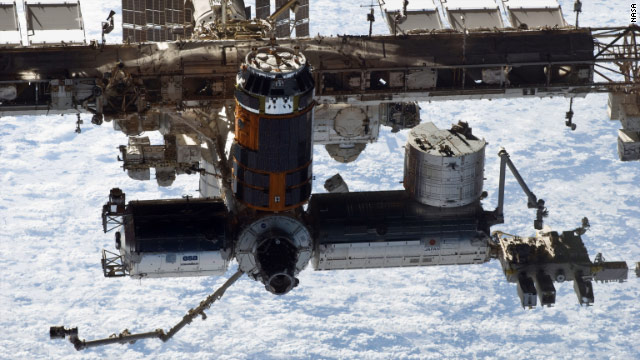
(CNN) -- Tuesday's space debris incident at the International Space Station was the "closest anything has come to the space station," NASA said Wednesday.
Final calculations showed the unknown object passed the space station 1,100 feet away and its source remains a mystery, according to Kelly Humphries, a spokesman at the Johnson Space Center in Houston, Texas.
When the unexpected space debris came flying close to the space station Tuesday, it prompted the station's six astronauts to take shelter inside two Soyuz capsules, NASA said.
NASA does not expect any other close calls with this particular debris, said Humphries.
Russia's Interfax news agency said preliminary data on "the dangerous approach" shows that the "trash" came within about 250 meters (820 feet) of the station.
Officials at NASA are investigating what the debris was, NASA spokesman Joshua Buck said.
By the time it was spotted, it was "too late to make an avoidance maneuver," so NASA ordered the six crew members to "shelter in place," Buck said. About 7:30 a.m. ET, the crew members climbed into the two Soyuz capsules positioned at the station.
NASA determined that the debris would come closest to the station at 8:08 a.m. ET.
Three minutes later, at 8:11 a.m. ET, the all-clear was sounded and astronauts were allowed to exit the capsules, Buck said.
Buck described the debris as an "unknown object of unknown size."
*
Note: Now there is confidence for you and to top it off, doesn't NASA (and NORAD) track most of the space junk up there? Just how did a piece of junk (an "unknown object of unknown size") sneak up on them, or was it even debris?
Sounds like space whale poop to me.
And speaking of fears, NASA's Director has something to tell us all:
Sounds like space whale poop to me.
And speaking of fears, NASA's Director has something to tell us all:
A Warning From NASA
Video Link
Note: Talk about cryptic, is this guy trying to insinuate that something bad could happen? What are they going to do, what till the last minute and say, "oh, by the way..."
Should we get ready to duck and cover? And just what is it they are not telling us? -SW
***********************************************
Friday, April 22, 2011
Videos- UFOs in Space and Our Alien Moon
Thought these videos have been around a while, they are worth reviewing again.
Video Link
Video Link
Video Link
Video Link
****************************************************
Video Link
*
Video Link
*
Video Link
*
Video Link
****************************************************
Friday, February 25, 2011
NASA- Discovery's last flight, the end of the Shuttle Program
The Beginning of the End
Video Link
Video Link
After months of delays, on Thursday, February 24, 2011, NASA Space Shuttle Discovery launched from Cape Canaveral, Florida on it's 39th and final trip into space.
Discovery will deliver new experiments and hardware to the International Space Station. Joining the six crew members is Robonaut 2, the first humanoid robot to fly in space.
Discovery's flight marks the retirement of NASA's shuttle fleet. Endeavor and Atlantis will make their final flights later this year.
*
The Beginning
Video Link
Who remembers the first shuttle launch off the back of a 747? I do.
The test flight of Shuttle Enterprise (NASA Orbiter Vehicle Designation: OV-101) on August 12, 1977, was one of the most thrilling events of my life. That test flight proved that man could ascend to the heavens above and then glide back to Earth in a reusable space ship.
I recall it well, the day Enterprise lifted off the back of the 747 and glided back to Edwards AFB, California. I was among other military familes as we gathered around a television set in the day room of the temporary family quarters at Ft. Eustes, Virginia. It was a thrilling, awe-inspiring sight for us all.
Although the Shuttle Enterprise was a prototype with no engines or heat shield, it could have (at great cost) been re-fitted and take it's place among the list of working shuttles. But alas, the program is coming to an end, Enterprise having never reached orbit.
Wouldn't it be wonderful if Enterprise flew the last mission into space? Sadly, that will never happen but we can dream, can't we?
**************************************************
Wednesday, November 24, 2010
Proof that NASA knows of Extraterrestrial Life?
Former Vancouver cable television manager Martyn Stubbs gathered evidence from NASA transmissions, that seems to point to the existence of extraterrestrial activity.
Stubbs revealed the incongruities he found in the 2,500 hours of space shuttle communications he recorded, by using his station's satellite technology over the course of five years.
Part 1
Video Link
Part 2
Video Link
Part 3
Video Link
Part 4
Video Link
Video Link
View more.
*******************************************************
Stubbs revealed the incongruities he found in the 2,500 hours of space shuttle communications he recorded, by using his station's satellite technology over the course of five years.
Part 1
Video Link
Part 2
Video Link
Part 3
Video Link
Part 4
Video Link
*
Video Link
View more.
*******************************************************
Monday, November 1, 2010
Astronaut Confirms ETs Are Here

by Clark C. McClelland, former ScO, U.S. Space Shuttle Fleet, KSC, Florida 1958 to 1992
Space Shuttle Columbia during STS-80 took a crew of five astronauts into a 17 day, 15 hour and 54 minute mission around the earth, the longest flight in the history of this vehicle. During this lengthy flight a very strange event occurred that even had crewman Dr. Story Musgrave unable to explain what he observed from the shuttle windows.
A large disc shaped object appeared below the Columbia. The shuttle was approximately, 190 Nautical miles high.

The disc was first observed to miraculously appear from out of nowhere, flying through the clouds below and progressing from right to left as the astronauts stared in utter amazement. The outer rim of the craft appeared to be rotating counter-clockwise. It was very large (compared to common space junk and breakaway ice), approximately 50 to 150 feet in diameter.
 Astronaut Dr. Story Musgrave, a Payload Specialist on the STS-80 Mission, was interviewed following the flight. As he viewed a videotape of the incident which showed lightning flashes in the atmosphere, the city lights of Denver, Colorado and other earthbound sights, he stated: "I don't know what it is. Whether it's a washer, debris, ice particles, I don't know. But it's characteristic of the thousands of things which I've seen. What is not so characteristic is it appears to come from no where. You would think that if it's facing the dark side or facing a side towards you which is not reflecting the sun, you would think that you would see something there. It's really impressive."
During an earlier interview, Dr. Musgrave stated he attempted to communicate with ET life forms during each of his six missions. He actually asked them to take him with them. Now that's an astronaut with a lot of courage. Dr. Musgrave retired after this flight from NASA. Since then he's been spreading his considered opinion that alien life exists. When Musgrave speaks of this, it's no great leap for one to assume he's admitting knowledge of alien life. As the final slide of a "Grey" ET was shown during a recent astronomy presentation by Dr. Musgrave, he made this surprising comment: "These guys are real... I guarantee it!" Dr. Musgrave does know the truth. This author guarantees it!
Consider that carefully. These are world renown scientists making statements almost beyond belief. Dr. von Braun and others of his stature have the courage to disclose "sensitive" information, but obviously the leaders of the USA and the world do not. If billions could find a way of coping with the overwhelming threat of atomic annihilation for half a century, it is reasonable to assume we can cope with the knowledge of these "Other Intelligence's" from the stars. We can cope with the fact they are visiting earth, and have been since the beginning of history. We must. Those still asleep must open their eyes. We Are Not Alone.
About the author:
Clark C. McClelland, former ScO, Space Shuttle Fleet, KSC, Florida 1958 to 1992. Former Director, NICAP Unit-3 at Cape Canaveral and KSC, former MUFON Assistant Florida State Director, and former Director, Kennedy Space Center MUFON Unit, KSC. LINK
Source- Agoracosmopolitan.com
Video Link
*****************************************************
Tuesday, February 2, 2010
Keep Tabs On The International Space Station

You can now get online streaming video of the crew at work on the International Space Station. When the lights 'go out', you can see an Earth view via external cameras.
NASA- Live Space Station Video
Live Space Station Video includes internal views from cameras in the International Space Station’s Destiny Laboratory and Harmony module when the resident astronauts are on duty. Earth views from external cameras on the station’s structure will be available during crew off-duty periods.
The video will be accompanied by live audio of conversations between the crew and the Mission Control network. When the space shuttle is docked to the station, the stream will include video and audio of those activities.
Television from the station is available only when the complex is in contact with the ground through its high-speed communications antenna and NASA's Tracking and Data Relay Satellite System. During "loss of signal" periods, Internet viewers may see a test pattern or a graphical world map that depicts the station’s location in orbit above the Earth using real-time telemetry sent to Mission Control from the station.
Since the station orbits the Earth once every 90 minutes, it sees a sunrise or a sunset every 45 minutes. When the station is in darkness, external camera video may appear black, but also may provide spectacular views of city lights below.
The streaming video is being webcast as part of NASA's celebration of the 10th anniversary of the space station in orbit.
Go to NASA's ISS website, or go directly to the video here.
ISS Sighting Opportunities / ISS Web Tracking Map
* * * * * * * * * * * * * * * * * * *
Tuesday, January 26, 2010
Are ETs at war in our solar system, or is the sun just 'letting off steam'?
NASA's SOHO (Solar and Heliospheric Observatory) spacecraft, which is meant to study the sun's activity, has captured some very unusual images.
Some claim that these objects are planets, or comets that have been caught in our sun's gravitation field, while some believe these are gigantic spacecraft of unknown origin, waging war in our solar system, around our sun.
Video Link
See more at DiscloseTV
* * *
And now these planet sized objects have been seen around the sun, beginning on January 18, 2010.
Video Link
* * *Or is it possible that all those theories of planets, comets, spacecraft, etc., are really just 'sun spit', the 'objects' simply ejected plasma. You watch and decide.
Video Link
Latest SOHO Images:
http://sohowww.nascom.nasa.gov/data/realtime-images.html
The SOHO Extreme ultraviolet Imaging Telescope:
http://umbra.nascom.nasa.gov/eit/
Solar images at SDAC:
http://umbra.nascom.nasa.gov/images/
Some claim that these objects are planets, or comets that have been caught in our sun's gravitation field, while some believe these are gigantic spacecraft of unknown origin, waging war in our solar system, around our sun.
Video Link
See more at DiscloseTV
* * *
And now these planet sized objects have been seen around the sun, beginning on January 18, 2010.
Video Link
* * *Or is it possible that all those theories of planets, comets, spacecraft, etc., are really just 'sun spit', the 'objects' simply ejected plasma. You watch and decide.
Video Link
Latest SOHO Images:
http://sohowww.nascom.nasa.gov/data/realtime-images.html
The SOHO Extreme ultraviolet Imaging Telescope:
http://umbra.nascom.nasa.gov/eit/
Solar images at SDAC:
http://umbra.nascom.nasa.gov/images/
Enjoy!
* * * * * * * * * *
* * * * * * * * * *
Thursday, August 13, 2009
UFOs accompany STS-127- 15 July, 2009

There have been many objects in space, alongside even our first satellite. NASA passes it off as 'space junk'.
This is NASA footage of the STS 127 Endeavour's external fuel tank, 15 July, 2009.
 Aside from the lobster like UFO and other unknown objects, watch to the right side of the fuel tank, where an elongated object appears at :35 second mark. Is that a wormhole ejecting a UFO, or is that some type of life form that we know nothing about?
 In other videos (NASA included), we see worm-like objects writhing in space and in our skies. There are also objects that appear to be long, curling clouds, that eject objects such as this one did. What these are for sure, no one yet knows.
Along with our satellites, the ISS and shuttles, there seems to be an abundance of intelligent "space junk" in orbit around our planet.
Subscribe to:
Posts (Atom)
LinkWithin
