
Showing posts with label Astronomy. Show all posts
Showing posts with label Astronomy. Show all posts
Wednesday, March 6, 2013
Another Asteroid Flyby For Saturday, March 9, 2013
*
Big Asteroid to Zoom By Earth This Weekend
Space.com- A newly discovered asteroid the size of a football field will cruise through Earth's neighborhood this weekend, just days after another space rock made an even closer approach to our planet.
The 330-foot-wide (100 meters) asteroid 2013 ET will miss Earth by 600,000 miles (960,000 kilometers) when it zips by on Saturday (March 9). The space rock flyby will come just days after the 33-foot (10 m) asteroid 2013 EC approached within 230,000 miles (370,000 km) of us early Monday (March 4).
When asteroid 2013 ET passes Earth, it will be at a range equivalent to 2.5 times the distance between the planet and the moon, making it too faint and far away for most stargazers to spot in the night sky. But the Virtual Telescope Project in Italy, run by astrophysicist Gianluca Masi, will webcast a live telescope view of the space rock's flyby on Friday (March 8), beginning at 2 p.m. EST (1900 GMT). You can access the free broadcast here: http://www.astrowebtv.org.
Read more here.
*******************************************************


Sunday, February 24, 2013
NASA Video: Loops of Plasma Rain Down On The Sun
Be it heavenly or hellish, our Sun is definitely beautiful!
Video Link
Eruptive events on the sun can be wildly different. Some come just with a solar flare, some with an additional ejection of solar material called a coronal mass ejection (CME), and some with complex moving structures in association with changes in magnetic field lines that loop up into the sun's atmosphere, the corona.
On July 19, 2012, an eruption occurred on the sun that produced all three. A moderately powerful solar flare exploded on the sun's lower right hand limb, sending out light and radiation. Next came a CME, which shot off to the right out into space. And then, the sun treated viewers to one of its dazzling magnetic displays -- a phenomenon known as coronal rain.
Read more here.
********************************************************
Saturday, February 16, 2013
Russian Meteor Unrelated To Asteroid Flyby
*
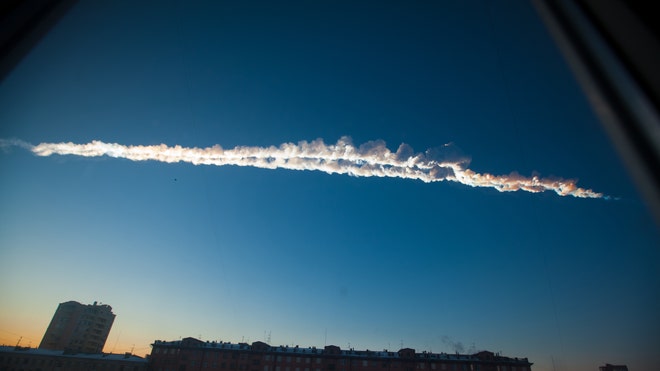
No, the Russians did not shoot down a UFO, despite some claims. Unfortunately for residents of Chelyabinsk, Russia, it was nothing more than a huge rock from space; a meteor/bolide which it happened to fall to earth only hours before asteroid 2012 DA14 made it's 17,200 mile pass (closer than many satellites)!
At the time of this posting, approximately 1200 people have been injured, in and around Chelyabinsk, mostly by flying glass. Many people may have been injured after having been knocked off their feet by the blast from the fireball.
According to the trajectory of the Chelyabinsk bolide, it had nothing to do with asteroid 1012 DA14... and it wasn't a UFO. -SW
* * *
Press Release: NASA Experts Discuss Russia Meteor in Media Teleconference Today
WASHINGTON
-- NASA experts will hold a teleconference for news media at 4 p.m. EST
today to discuss a meteor that streaked through the skies over Russia's
Urals region this morning.
Scientists have determined the Russia meteor is not related to asteroid 2012 DA14 that will safely pass Earth today at a distance of more than 17,000 miles. Early assessments of the Russia meteor indicate it was about one-third the size of 2012 DA14 and traveling in a different direction.
Panelists for the teleconference are:
-- Bill Cooke, lead for the Meteoroid Environments Office at NASA's Marshall Space Flight Center in Huntsville, Ala.
-- Paul Chodas, research scientist in the Near Earth Object Program Office at NASA's Jet Propulsion Laboratory in Pasadena, Calif.
News media interested in participating should dial 888-843-7186 and use the passcode METEOR.
The teleconference will be carried live online at:
For detailed information concerning the Earth flyby of 2012 DA14, visit:
*

*
About 1,100 injured as meteorite hits Russia with force of atomic bomb
A meteor streaked across the sky and exploded over Russia's Ural Mountains with the power of an atomic bomb Friday, its sonic blasts shattering countless windows and injuring about 1,100 people.
The spectacle deeply frightened many Russians, with some elderly women declaring that the world was coming to an end. Many of the injured were cut by flying glass as they flocked to windows, curious about what had produced such a blinding flash of light.
The meteor -- estimated to be about 10 tons and 49 feet wide -- entered the Earth's atmosphere at a hypersonic speed of at least 33,000 mph and shattered into pieces about 18-32 miles above the ground, the Russian Academy of Sciences said in a statement. But even small asteroids pack a tremendous punch, explained Andrew Cheng of the Johns Hopkins Applied Physics Laboratory.
"It doesn’t take a very large object. A 10-meter size object already packs the same energy as a nuclear bomb," Cheng, who led a 2000-2001 mission for NASA to orbit and land on an asteroid, told FoxNews.com.
Amateur video showed an object speeding across the sky about 9:20 a.m. local time, just after sunrise, leaving a thick white contrail and an intense flash.
"There was panic. People had no idea what was happening," said Sergey Hametov, a resident of Chelyabinsk, a city of 1 million about 930 miles east of Moscow.
"We saw a big burst of light, then went outside to see what it was and we heard a really loud, thundering sound," he told The Associated Press by telephone.
The meteor hit less than a day before Asteroid 2012 DA14 is to make the closest recorded pass of an asteroid to the Earth for a rock of its size -- about 17,150 miles. But the European Space Agency said its experts had determined there was no connection -- just cosmic coincidence.
The meteor released several kilotons of energy above the region, the Russian science academy said. According to NASA, it was about 15 meters or 49 feet wide before it hit the atmosphere, about one-third the size of the passing asteroid.
Some meteorite fragments fell in a reservoir outside the town of Chebarkul. The crash left a 26-foot-wide crater in the ice.
The shock wave blew in more than 1 million square feet of glass, according to city officials, who said 3,000 buildings in the city were damaged. At one zinc factory, part of the roof collapsed.
The Interior Ministry said about 1,100 people sought medical care after the shock wave and 48 of them were hospitalized. Most of the injuries were caused by flying glass, officials said.
There was no immediate word on any deaths or anyone struck by space fragments.
Continue reading here.
*
Video Link
*
Youtube video courtesy Alexandr Ivanov
* Russian meteorite crash: LIVE UPDATES
* * *
Russia Meteor Not Linked to Asteroid Flyby
Source: NASA
NASA statement on Russia meteor:
"According to NASA scientists, the trajectory of the Russia meteor was significantly different than the trajectory of the asteroid 2012 DA14, making it a completely unrelated object. Information is still being collected about the Russia meteor and analysis is preliminary at this point. In videos of the meteor, it is seen to pass from left to right in front of the rising sun, which means it was traveling from north to south. Asteroid DA14's trajectory is in the opposite direction, from south to north."
Update: February 15, 2013 7pm PST
New information provided by a worldwide network of sensors has allowed scientists to refine their estimates for the size of the object that entered that atmosphere and disintegrated in the skies over Chelyabinsk, Russia, at 7:20:26 p.m. PST, or 10:20:26 p.m. EST on Feb. 14 (3:20:26 UTC on Feb. 15).
The estimated size of the object, prior to entering Earth's atmosphere, has been revised upward from 49 feet (15 meters) to 55 feet (17 meters), and its estimated mass has increased from 7,000 to 10,000 tons. Also, the estimate for energy released during the event has increased by 30 kilotons to nearly 500 kilotons of energy released. These new estimates were generated using new data that had been collected by five additional infrasound stations located around the world – the first recording of the event being in Alaska, over 6,500 kilometers away from Chelyabinsk. The infrasound data indicates that the event, from atmospheric entry to the meteor's airborne disintegration took 32.5 seconds. The calculations using the infrasound data were performed by Peter Brown at the University of Western Ontario, Canada.
"We would expect an event of this magnitude to occur once every 100 years on average," said Paul Chodas of NASA's Near-Earth Object Program Office at the Jet Propulsion Laboratory in Pasadena, Calif. "When you have a fireball of this size we would expect a large number of meteorites to reach the surface and in this case there were probably some large ones."
The trajectory of the Russia meteor was significantly different than the trajectory of the asteroid 2012 DA14, which hours later made its flyby of Earth, making it a completely unrelated object. The Russia meteor is the largest reported since 1908, when a meteor hit Tunguska, Siberia.
_________________________________________________________
Preliminary information indicates that a meteor in Chelyabinsk, Russia, is not related to asteroid 2012 DA14, which is flying by Earth safely today.
The Russia meteor is the largest reported since 1908, when a meteor hit Tunguska, Siberia. The meteor entered the atmosphere at about 40,000 mph (18 kilometers per second). The impact time was 7:20:26 p.m. PST, or 10:20:26 p.m. EST on Feb. 14 (3:20:26 UTC on Feb. 15), and the energy released by the impact was in the hundreds of kilotons.
Based on the duration of the event, it was a very shallow entry. It was larger than the meteor over Indonesia on Oct. 8, 2009. Measurements are still coming in, and a more precise measure of the energy may be available later. The size of the object before hitting the atmosphere was about 49 feet (15 meters) and had a mass of about 7,000 tons.
The meteor, which was about one-third the diameter of asteroid 2012 DA14, was brighter than the sun. Its trail was visible for about 30 seconds, so it was a grazing impact through the atmosphere.
It is important to note that this estimate is preliminary, and may be revised as more data is obtained.
http://www.nasa.gov/topics/solarsystem/features/asteroidflyby.html
DC Agle 818-393-9011
Jet Propulsion Laboratory, Pasadena, Calif.
agle@jpl.nasa.gov
2013-061
*******************************************************
No, the Russians did not shoot down a UFO, despite some claims. Unfortunately for residents of Chelyabinsk, Russia, it was nothing more than a huge rock from space; a meteor/bolide which it happened to fall to earth only hours before asteroid 2012 DA14 made it's 17,200 mile pass (closer than many satellites)!
At the time of this posting, approximately 1200 people have been injured, in and around Chelyabinsk, mostly by flying glass. Many people may have been injured after having been knocked off their feet by the blast from the fireball.
According to the trajectory of the Chelyabinsk bolide, it had nothing to do with asteroid 1012 DA14... and it wasn't a UFO. -SW
* * *
Press Release: NASA Experts Discuss Russia Meteor in Media Teleconference Today
Scientists have determined the Russia meteor is not related to asteroid 2012 DA14 that will safely pass Earth today at a distance of more than 17,000 miles. Early assessments of the Russia meteor indicate it was about one-third the size of 2012 DA14 and traveling in a different direction.
Panelists for the teleconference are:
-- Bill Cooke, lead for the Meteoroid Environments Office at NASA's Marshall Space Flight Center in Huntsville, Ala.
-- Paul Chodas, research scientist in the Near Earth Object Program Office at NASA's Jet Propulsion Laboratory in Pasadena, Calif.
News media interested in participating should dial 888-843-7186 and use the passcode METEOR.
The teleconference will be carried live online at:
For detailed information concerning the Earth flyby of 2012 DA14, visit:
*
*
About 1,100 injured as meteorite hits Russia with force of atomic bomb
A meteor streaked across the sky and exploded over Russia's Ural Mountains with the power of an atomic bomb Friday, its sonic blasts shattering countless windows and injuring about 1,100 people.
The spectacle deeply frightened many Russians, with some elderly women declaring that the world was coming to an end. Many of the injured were cut by flying glass as they flocked to windows, curious about what had produced such a blinding flash of light.
The meteor -- estimated to be about 10 tons and 49 feet wide -- entered the Earth's atmosphere at a hypersonic speed of at least 33,000 mph and shattered into pieces about 18-32 miles above the ground, the Russian Academy of Sciences said in a statement. But even small asteroids pack a tremendous punch, explained Andrew Cheng of the Johns Hopkins Applied Physics Laboratory.
"It doesn’t take a very large object. A 10-meter size object already packs the same energy as a nuclear bomb," Cheng, who led a 2000-2001 mission for NASA to orbit and land on an asteroid, told FoxNews.com.
Amateur video showed an object speeding across the sky about 9:20 a.m. local time, just after sunrise, leaving a thick white contrail and an intense flash.
"There was panic. People had no idea what was happening," said Sergey Hametov, a resident of Chelyabinsk, a city of 1 million about 930 miles east of Moscow.
"We saw a big burst of light, then went outside to see what it was and we heard a really loud, thundering sound," he told The Associated Press by telephone.
The meteor hit less than a day before Asteroid 2012 DA14 is to make the closest recorded pass of an asteroid to the Earth for a rock of its size -- about 17,150 miles. But the European Space Agency said its experts had determined there was no connection -- just cosmic coincidence.
The meteor released several kilotons of energy above the region, the Russian science academy said. According to NASA, it was about 15 meters or 49 feet wide before it hit the atmosphere, about one-third the size of the passing asteroid.
Some meteorite fragments fell in a reservoir outside the town of Chebarkul. The crash left a 26-foot-wide crater in the ice.
The shock wave blew in more than 1 million square feet of glass, according to city officials, who said 3,000 buildings in the city were damaged. At one zinc factory, part of the roof collapsed.
The Interior Ministry said about 1,100 people sought medical care after the shock wave and 48 of them were hospitalized. Most of the injuries were caused by flying glass, officials said.
There was no immediate word on any deaths or anyone struck by space fragments.
Continue reading here.
*
Video Link
*
Youtube video courtesy Alexandr Ivanov
* Russian meteorite crash: LIVE UPDATES
* * *
Russia Meteor Not Linked to Asteroid Flyby
Source: NASA
NASA statement on Russia meteor:
"According to NASA scientists, the trajectory of the Russia meteor was significantly different than the trajectory of the asteroid 2012 DA14, making it a completely unrelated object. Information is still being collected about the Russia meteor and analysis is preliminary at this point. In videos of the meteor, it is seen to pass from left to right in front of the rising sun, which means it was traveling from north to south. Asteroid DA14's trajectory is in the opposite direction, from south to north."
Update: February 15, 2013 7pm PST
New information provided by a worldwide network of sensors has allowed scientists to refine their estimates for the size of the object that entered that atmosphere and disintegrated in the skies over Chelyabinsk, Russia, at 7:20:26 p.m. PST, or 10:20:26 p.m. EST on Feb. 14 (3:20:26 UTC on Feb. 15).
The estimated size of the object, prior to entering Earth's atmosphere, has been revised upward from 49 feet (15 meters) to 55 feet (17 meters), and its estimated mass has increased from 7,000 to 10,000 tons. Also, the estimate for energy released during the event has increased by 30 kilotons to nearly 500 kilotons of energy released. These new estimates were generated using new data that had been collected by five additional infrasound stations located around the world – the first recording of the event being in Alaska, over 6,500 kilometers away from Chelyabinsk. The infrasound data indicates that the event, from atmospheric entry to the meteor's airborne disintegration took 32.5 seconds. The calculations using the infrasound data were performed by Peter Brown at the University of Western Ontario, Canada.
"We would expect an event of this magnitude to occur once every 100 years on average," said Paul Chodas of NASA's Near-Earth Object Program Office at the Jet Propulsion Laboratory in Pasadena, Calif. "When you have a fireball of this size we would expect a large number of meteorites to reach the surface and in this case there were probably some large ones."
The trajectory of the Russia meteor was significantly different than the trajectory of the asteroid 2012 DA14, which hours later made its flyby of Earth, making it a completely unrelated object. The Russia meteor is the largest reported since 1908, when a meteor hit Tunguska, Siberia.
_________________________________________________________
Preliminary information indicates that a meteor in Chelyabinsk, Russia, is not related to asteroid 2012 DA14, which is flying by Earth safely today.
The Russia meteor is the largest reported since 1908, when a meteor hit Tunguska, Siberia. The meteor entered the atmosphere at about 40,000 mph (18 kilometers per second). The impact time was 7:20:26 p.m. PST, or 10:20:26 p.m. EST on Feb. 14 (3:20:26 UTC on Feb. 15), and the energy released by the impact was in the hundreds of kilotons.
Based on the duration of the event, it was a very shallow entry. It was larger than the meteor over Indonesia on Oct. 8, 2009. Measurements are still coming in, and a more precise measure of the energy may be available later. The size of the object before hitting the atmosphere was about 49 feet (15 meters) and had a mass of about 7,000 tons.
The meteor, which was about one-third the diameter of asteroid 2012 DA14, was brighter than the sun. Its trail was visible for about 30 seconds, so it was a grazing impact through the atmosphere.
It is important to note that this estimate is preliminary, and may be revised as more data is obtained.
http://www.nasa.gov/topics/solarsystem/features/asteroidflyby.html
DC Agle 818-393-9011
Jet Propulsion Laboratory, Pasadena, Calif.
agle@jpl.nasa.gov
2013-061
*******************************************************
Sunday, February 10, 2013
Asteroid 2012 DA14 - A Meteoric Close Shave Predicted
 |
| Depiction of the trajectory of asteroid 2012 DA14 on Feb 15, 2013. In
this view, we are looking down from above Earth's north pole. Image credit: NASA/JPL-Caltech |
*
There is a 150ft wide rock headed for Earth. Traveling between 12,427mph (20,000kph) and 18,641mph (30,000kph), asteroid 2012 DA14 is expected to fly by, even closer than the orbits of high geostationary telecommunications and weather satellites. Some of those satellites are 22,000 miles (35,406km) above Earth. However, experts calculate that on February 15, 2013, 2012 DA14 will skim by Earth at a distance of approximately 17,200 miles (27,681km).
Well, that's a relief! A 330ft meteor is believed to have been the cause of the 1908 explosion over a remote region of Siberia, known as Tunguska. Although that object exploded a short distance above the ground, it generated a blast that was 1000 times more destructive than the A-bomb dropped on Hiroshima. The 1908 explosion completely flattened 830 square miles (2,150 sq km) of Tunguska forest.
Don't put off getting those flowers, chocolates, or other Valentine treats for your honey. 2012 DA14 is predicted to be at it closest approach at approximately 1:30 PM Friday (the 15th), Texas time.
-Sunny Williams
*
NASA's Near Earth Object Program, 2012 DA14 Earth Impact Risk Summary
NASA 2012 DA14 Flyby with videos
Near-Earth Asteroid 2012 DA14 to make extremely close approach in February 2013
*******************************************************
Wednesday, December 5, 2012
Voyage 1 set to step into Interstellar Space
 |
| Voyage I Source: trbimg.com |
*
Voyager 1 Enters Magnetic Highway, AKA the Last Step to Interstellar Space
NASA scientists say Voyager 1 could enter interstellar space anywhere from months to a couple of years from now
NASA's Voyager 1 is traveling through the last leg of its journey before entering interstellar space.
Voyager 1, which was launched into space in 1977 to eventually explore interstellar space and become the most distant human-made object, has reached a region that NASA scientists are calling a magnetic highway. This highway consists of charged particles where the sun's magnetic field lines are connected to interstellar magnetic field lines.
This area is still considered part of our heliosphere, which is a bubble of charged particles around the sun, because the direction of the magnetic field lines has not changed. The direction of these lines will change when Voyager 1 enters interstellar space, and scientists believe the magnetic highway is the last stretch before finally making it to interstellar space.
"Although Voyager 1 still is inside the sun's environment, we now can taste what it's like on the outside because the particles are zipping in and out on this magnetic highway," said Edward Stone, Voyager project scientist based at the California Institute of Technology, Pasadena. "We believe this is the last leg of our journey to interstellar space. Our best guess is it's likely just a few months to a couple years away. The new region isn't what we expected, but we've come to expect the unexpected from Voyager."
Continue reading...
*
What will our little 'messenger of peace' find out there, in the vastness of space between star systems? For good or ill, Voyager treks on in search of other worlds, other solar systems.
What might it find?
I am reminded of "Star Trek - The Movie", where a massive ship approaches Earth, seeking it's creator. If it doesn't find "the creator", "V'ger" will destroy planet Earth.
The crew of the Enterprise finally deduce that V'ger is actually "Voyager 6". While in deep interstellar space, Voyager 6 is found by a superior race of (probably) cybernetic aliens, who repair the tiny craft, place it at the core of a massive ship, pat it's little metal bottom and send it home to daddy. The mission: Join with the creator, or destroy.
Oh my!
Lucky for us, there never was a Voyager 6. NASA only sent two Voyagers into space.
The thought still remains. Let's just hope we never have to live out that scenario with V-1, or V-2. The real Captain Kirk and Mr. Spock might not be so clever, as in the movies.
-Sunny Williams/LITS
NASA's Voyager Program
*******************************************************
Monday, December 3, 2012
What's Up For December Skies
 |
| Constellations Courtesy oneminuteastronomer.com |
*
Each month there is something magical about our night skies. You just have to look up to see the wonder and beauty of the universe.
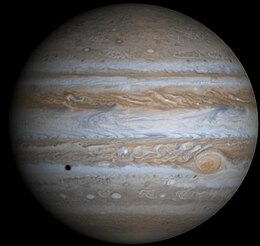
Jupiter at Opposition
 |
| A Cassini image of Jupiter and Europa's shadow. |
(Dec. 3, 2012) The big planet will be at its closest approach to Earth, with it's face fully illuminated by the Sun. If you have a large telescope and camera, there is no better time to view and photograph Jupiter and its many moons.
Switching partners
At the start of December, Saturn and Venus began moving away from each other, until Saturn takes on the waning crescent Moon, as it's new partner. Before daybreak on December 10, Saturn and the moon will partner up and then before the sun rises on Dec. 11, Venus will once again partner up with the Moon.
Shooting stars
Watch from late evening to early morning hours, the Geminid meteor shower (Dec. 4-17), which will peak on the night of Dec. 13-14. At it's best, the Geminids could possibly produce up to 120 meteors per hour and will appear to radiate from the constellation Gemini (thus the name).
*
Sources:
One Minute Astronomer
Jupiter- Wikipedia
Meteor Showers Online
*******************************************************
Tuesday, November 20, 2012
Satellites Above - What's Up?
 |
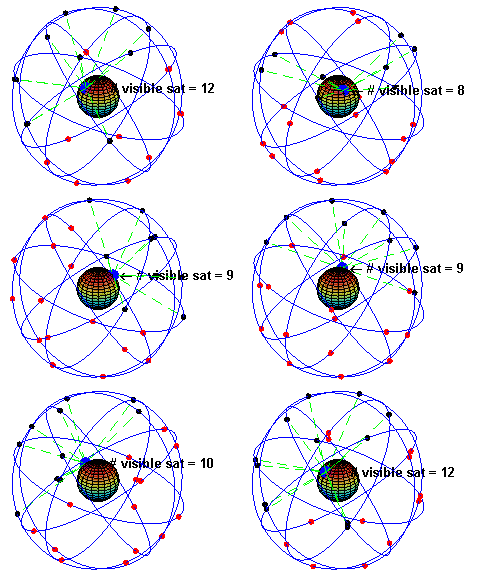
| Satellite Orbits Courtesy Suntrek.org |
I've received numerous emails from people all over, who think they may have seen a satellite in orbit. Well, what is a satellite? A satellite is an object that orbits (revolves) around another object. Our moon is a natural satellite. Objects put into orbit around our planet (and others) by human endeavors, are called artificial satellites.
Some satellites can be see with the naked eye, by observers on the ground. These are generally low earth orbit (LEO) satellites, while other satellites orbit too far out from our planet to be visible without a powerful telescope.
With today's technology, anyone can track most of the satellites in orbit around Earth. For those of you attached to your mobile phones, there's an app for that.
Meanwhile, here is some useful information on satellites, which I hope will increase your star-gazing pleasure. -SW
Suntrek- "What do satellites do?"
Geostationary Orbit (GEO)
These satellites are in orbit above the Earth's equator. They stay above the same location on Earth. They are used for telecommunications, television transmission and for navigation.
Low Earth orbit (LEO)
A satellite has a Low Earth Orbit when it orbits somewhere between 300 and 800 km above the Earth's surface. These satellites only take about 90 minutes to go around the Earth. They are ideal for making observations of the Earth's resources.
Polar Orbits
A polar orbit is a special LEO in which a satellite travels north-south over the Earth's poles, rather than in the more usual east-west direction. Polar orbits can be used to map the complete Earth once a day. This is needed for weather forecasts.
Global Positioning System (GPS) satellites
This is a fleet of satellites which allows us to know exactly where on Earth we are.
Information:
NASA- What is a satellite
Satellite- From Wikipedia, the free encyclopedia (a must read)
Visual Satellite Observer's Home Page
REAL TIME SATELLITE TRACKING (Track satellites & ISS live on your computer)
List of Earth observation satellites
The Ten Most Important Satellites Orbiting Earth Now
Apps (Some are free, some are not)
GoSatWatch - Satellite Tracking for iPhone, iPad or iPod touch
3D Satellite Tracker for Android
Satellite AR
NASA Apps
Miscellaneous Apps listed on HobbySpace.com
*******************************************************
Saturday, November 10, 2012
COULD A SOLAR FLARE BE THE END OF US?
Video Link
Last night I watched "THE KILLSHOT: APPROACHING THE MOMENT", on DVD. According to Major Ed Dames (ret.), remote viewers have seen a doomsday scenario, in which the Earth will be devastated by a tremendous solar flare. It isn't that far fetched, as signs keep pointing to that most real possibility.
On Tuesday, August 6, 2011, an x6.9 flare was recorded. Then on Monday, October 22, 2012, NASA's Solar Dynamics Observatory (SDO) captured the sun erupting with an X1.8 class solar flare. The solar flare came from an active region on the left side of the sun known as AR 1598. This area of the sun has been known as a source of weaker flares.
So the October 22, 2012 flare was weaker than the one on August 6, 2011. Does that mean the sun's flare activity is winding down? No, NASA predictes 2013 (May) will see solar storms building towards a peak, though at the same time, they claim that killer solar storms are an impossibility. Gee, that still doesn't sound very reassuring.
So just what are solar flares? Flares occur when powerful magnetic fields in and around the sun reconnect. Often associated with active regions on the sun's surface, where the magnetic fields are strongest and seen as sun spots. Classified according to their strength, the smallest flares are B-class, followed by C, M and X, which is the largest. Each letter represents a ten-fold increase in energy output. Therefore, an X is 10 times an M and 100 times a C.
There is also another scale within each letter class, these range from 1 to 9. C-class flares have little noticeable affect on Earth but M-class flares can cause brief radio blackouts at the North and South poles and produce minor radiation storms which could endanger astronauts. X is the last letter and most powerful class, however, there are flares 10 times more powerful than an X1 and X-class flares can go higher than 9.
In 2003, a very powerful flare was recorded (during the last solar maximum). That particularly powerful flare overloaded the sensors that were measuring it (the sensors cut-out at X28). A powerful X-class flare such as that can create long lasting radiation storms, harm satellites, create global transmission problems, cause world-wide blackouts and even airline passengers flying near the poles, could receive small doses of radiation.
On the cloudless British morning of Thursday, September 1, 1859, solar astronomer Richard Carrington took note of and drew a representation, of the sunspots he saw through the projected image from his 11 inch wide telescope. Before dawn the next day, skies all over the Earth erupted in red, purple and green auroras, which were so brilliant, that newspapers could be read as if it were daylight. Auroras could even be seen as far south as Cuba, Jamaica, the Bahamas, El Salvador and even in Hawaii.
That wasn't the end of the story for the "Carrington Flare." Telegraph systems worldwide, went haywire. Sparks discharged, shocking telegraph operators, even setting fire to telegraph paper. Not only that, when telegraphers disconnected the batteries powering the telegraph lines, the aurora-induced electric currents in the wires still allowed messages to be transmitted, though many messages were gibberish.
So what would happen if a flare like the 1859 flare occurred? Or how about that mega-flare that Major Ed Dames' remote viewers have seen in our near future? Power grids all over the world would go down and all electronic communications would cease. Satellites would be fried. The International Space Station would be no protection for the astronauts and airplanes could conceivably fall from the sky. There would be no phones, no TV, no Internet and no microwave ovens. And if you were out in it, you'd probably have a really nasty sunburn and a huge dose of radiation. Bummer!
Society would most likely be knocked back to (at least temporarily), that day in 1859, minus the telegraph. Such circumstances could last anywhere from a few months, to years! That wouldn't be so bad now, would it? Well, maybe so. I've finally gotten used to "texting".
-Sunny Williams
[Author's Note: Though I do find this subject to be very serious and know that such a mega solar event could possibly kill millions, if not billions of people, humor is my preferred choice of self defense (instead of uncontrollable sobbing).]
Video link
*
Additional Links and Sources:
THE KILLSHOT.COM
Solar Storms Building Toward Peak in 2013, NASA Predicts
NASA Observatory Captures Another X-Class Solar Flare
2012: Killer Solar Flares Are a Physical Impossibility
New Solar Cycle Prediction
Solar Storm of 1859
Solarwatcher.net
**************************************************
Tuesday, November 6, 2012
Know When The ISS Will Pass Over You
 |
| International Space Station |
New! Spot The Station
How many times have people witnessed a bright glowing object passing overhead, in the predawn or post sunset sky, then thought they had just seen a UFO? Plenty!
Sure, there are things out there in the skies that can't be easily explained but many things are not definitely not of extraterrestrial origin.
The international Space Station is easily the third brightest object in the sky, just after the sun and moon. If you know when and where to look, you can easily identify it as it passes by.
NASA now has "Spot the Station" service, which will send you an email or phone text message, a few hours before the space station passes over your house.
I just signed up for it. It easy!
Simply go to Spot The Station ( http://spotthestation.nasa.gov/ ), and choose your country, state and the closest city listed. Supply your email address or phone number (SMS enabled phone required), then receive a code and finish registering. That's it!
You can also choose the time of sightings your prefer, such as mornings, evenings, or anytime.
Or if you prefer, you can still go to NASA's Human Space Flight site and check the schedules. Either way, enjoy!
-Sunny
**************************************************
Sunday, October 28, 2012
Science News Sunday October 28, 2012
* * * * *

Finding amazing Science in the News and bringing it to you here each Sunday, starting today!
*
Huge 'Zombie' Alien Planet Rises from the Dead
A new planet has 'risen' from the dead...
Mars Methane Mystery: Curiosity Rover May Find New Clues
Curiosity digging up the latest dirt on Mars...
SpaceX cargo ship heads back to Earth after station visit
A round trip ticket to the ISS, SpaceX heads home.
Cassini records Saturn mega-storm, and incredible burp, for history
Saturn burps for posterity.
How Paintballs Could Save Earth from Giant Asteroid Impact
Play warfare in space with 'killer asteroid' Apophis.
***************************************************
Wednesday, October 17, 2012
In Search Of The "Dyson Sphere"- Scientists Receive Funding
 |
| A star-surrounding Dyson Sphere could be solid, swarm-like, or anywhere in between. (source: Sentient Developments) |
Astroboffins to search for mega-massive alien power plants
Dyson Spheres – not just for Star Trek anymore
Posted in Science, 5th October 2012 20:01 GMT
Lead by assistant professor Jason Wright of Penn State's Department of Astronomy & Astrophysics, the team will use NASA's Wide-field Infrared Survey Explorer (WISE) to search the sky for the infrared fingerprints of possible Dyson Spheres, energy-capturing mega-structures named after all-around smart guy Freeman Dyson, who postulated their existence in a 1960 paper.
According to Dyson, any advanced civilization would inevitably use up all of the resources on their planet, and would be forced to look elsewhere for energy. The most obvious place, he surmised, would be the star around which their planet orbits.
To capture that energy, they would construct the aforementioned Spheres – mind-bogglingly immense structures that would surround the star and collect its energy. These structures could be actual spheres, but more likely would take the form of rings, swarms, or banded spherical collections of energy harvesters.
No matter what form they might take, they'd undoubtedly give off infrared radiation that could be detected by such sensitive sensors such as those aboard WISE – and that's where Wright and his team come in.
The Atlantic reports that Wright has been awarded funding from the John Templeton Foundation to conduct his search, in response to his proposal, "Constraining the Abundance of Kardashev Type II and III Civilizations From Large Area Infrared Surveys".
We'll get back to Kardashev's civilization types in a moment.
Continue reading here: The Register
**************************************************
Monday, October 15, 2012
The Orionid Meteor Shower Begins Tonight
 |
| Best time to view the meteor shower will be between 3:00 a.m. and sunrise, or at least 2 hours before dawn. |
The Orionid meteor shower begins tonight and will peak Saturday, Oct. 21, 2012.
Tonight the Earth will begin to pass through a stream of dusty debris from Halley's Comet, treating sky watchers to one of the most dazzling meteor showers of the year.
Though not the strongest, the Orionids are truly one of the most beautiful annual meteor showers. But be prepared as the Orionid meteoroids are some of the fastest, clocking in at 148,000 mph as they hit the earth's atmosphere.
These meteors are called Orionids because they appear to come from a small spot in the sky, near the shoulder of Orion (the constellation), and these meteoroids fan out across the entire sky. Weather permitting, it should be a fantastic show.
**************************************************
Saturday, September 15, 2012
Mystery Spheres on Mars Have Scientists Scratching Their Heads
 |
| PHOTO CREDIT: NASA/JPL-Caltech/Cornell Univ./ USGS/Modesto Junior College and Space.com |
Strange Mystery Spheres on Mars Baffle Scientists
Space.com- A strange picture of odd, spherical rock formations on Mars from NASA's Opportunity rover has scientists scratching their heads over what exactly they're looking at.
The new Mars photo by Opportunity shows a close-up of a rock outcrop called Kirkwood covered in blister-like bumps that mission scientists can't yet explain. At first blush, the formations appear similar to so-called Martian "blueberries" — iron-rich spherical formations first seen by Opportunity in 2004 — but they actually differ in several key ways, scientist said.
"This is one of the most extraordinary pictures from the whole mission," said rover mission principal investigator Steve Squyres of Cornell University in Ithaca, N.Y., in a statement. "Kirkwood is chock full of a dense accumulation of these small spherical objects. Of course, we immediately thought of the blueberries, but this is something different. We never have seen such a dense accumulation of spherules in a rock outcrop on Mars."
Continue reading at Space.com
**************************************************
Saturday, September 1, 2012
BLUE MOON OVER TEXAS

I took several photos of the Blue Moon last night, August 31, 2012. This was my favorite, a shot of the full moon behind Mesquite trees.
If you took a photo of the blue moon and would like to share it, send it in and I will be glad to post it for others to enjoy.
Note: The next blue moon (2 full moons in one calendar month) will occur July 2nd and July 31, 2015.
To see a complete list of full moons dates between the years 1900 and 2100, go here.
-Sunny
**************************************************
Wednesday, August 29, 2012
Kepler Finds A Stellar Duo With Multiple Planets
*
*
NASA's Kepler Discovers Multiple Planets Orbiting a Pair of Stars
(NASA) Coming less than a year after the announcement of the first circumbinary planet, Kepler-16b, NASA's Kepler mission has discovered multiple transiting planets orbiting two suns for the first time. This system, known as a circumbinary planetary system, is 4,900 light-years from Earth in the constellation Cygnus.
This discovery proves that more than one planet can form and persist in the stressful realm of a binary star and demonstrates the diversity of planetary systems in our galaxy.
Astronomers detected two planets in the Kepler-47 system, a pair of orbiting stars that eclipse each other every 7.5 days from our vantage point on Earth. One star is similar to the sun in size, but only 84 percent as bright. The second star is diminutive, measuring only one-third the size of the sun and less than 1 percent as bright.
"In contrast to a single planet orbiting a single star, the planet in a circumbinary system must transit a 'moving target.' As a consequence, time intervals between the transits and their durations can vary substantially, sometimes short, other times long," said Jerome Orosz, associate professor of astronomy at San Diego State University and lead author of the paper. "The intervals were the telltale sign these planets are in circumbinary orbits."
The inner planet, Kepler-47b, orbits the pair of stars in less than 50 days. While it cannot be directly viewed, it is thought to be a sweltering world, where the destruction of methane in its super-heated atmosphere might lead to a thick haze that could blanket the planet. At three times the radius of Earth, Kepler-47b is the smallest known transiting circumbinary planet.
The outer planet, Kepler-47c, orbits its host pair every 303 days, placing it in the so-called "habitable zone," the region in a planetary system where liquid water might exist on the surface of a planet. While not a world hospitable for life, Kepler-47c is thought to be a gaseous giant slightly larger than Neptune, where an atmosphere of thick bright water-vapor clouds might exist.
"Unlike our sun, many stars are part of multiple-star systems where two or more stars orbit one another. The question always has been -- do they have planets and planetary systems? This Kepler discovery proves that they do," said William Borucki, Kepler mission principal investigator at NASA's Ames Research Center in Moffett Field, Calif. "In our search for habitable planets, we have found more opportunities for life to exist."
To search for transiting planets, the research team used data from the Kepler space telescope, which measures dips in the brightness of more than 150,000 stars. Additional ground-based spectroscopic observations using telescopes at the McDonald Observatory at the University of Texas at Austin helped characterize the stellar properties. The findings are published in the journal Science.
"The presence of a full-fledged circumbinary planetary system orbiting Kepler-47 is an amazing discovery," said Greg Laughlin, professor of Astrophysics and Planetary Science at the University of California in Santa Cruz. "These planets are very difficult to form using the currently accepted paradigm, and I believe that theorists, myself included, will be going back to the drawing board to try to improve our understanding of how planets are assembled in dusty circumbinary disks."
Ames manages Kepler's ground system development, mission operations and science data analysis. NASA's Jet Propulsion Laboratory in Pasadena, Calif., managed the Kepler mission development.
Ball Aerospace & Technologies Corp. in Boulder, Colo., developed the Kepler flight system and supports mission operations with the Laboratory for Atmospheric and Space Physics at the University of Colorado in Boulder.
The Space Telescope Science Institute in Baltimore archives, hosts and distributes Kepler science data. Kepler is NASA's tenth Discovery Mission and funded by NASA's Science Mission Directorate at the agency's headquarters in Washington.
Source: NASA
More: NASA News Release
**************************************************
 |
| The planets Kepler-47b and Kepler-47c: Kepler-47b has three times the radius of earth and orbits the pair of stars in less than 50 days while Kepler-47c is thought to be a gaseous giant, slightly larger than Neptune with an orbital period of 303 days. Credit: NASA/JPL-Caltech/T. Pyle |
*
NASA's Kepler Discovers Multiple Planets Orbiting a Pair of Stars
(NASA) Coming less than a year after the announcement of the first circumbinary planet, Kepler-16b, NASA's Kepler mission has discovered multiple transiting planets orbiting two suns for the first time. This system, known as a circumbinary planetary system, is 4,900 light-years from Earth in the constellation Cygnus.
This discovery proves that more than one planet can form and persist in the stressful realm of a binary star and demonstrates the diversity of planetary systems in our galaxy.
Astronomers detected two planets in the Kepler-47 system, a pair of orbiting stars that eclipse each other every 7.5 days from our vantage point on Earth. One star is similar to the sun in size, but only 84 percent as bright. The second star is diminutive, measuring only one-third the size of the sun and less than 1 percent as bright.
"In contrast to a single planet orbiting a single star, the planet in a circumbinary system must transit a 'moving target.' As a consequence, time intervals between the transits and their durations can vary substantially, sometimes short, other times long," said Jerome Orosz, associate professor of astronomy at San Diego State University and lead author of the paper. "The intervals were the telltale sign these planets are in circumbinary orbits."
The inner planet, Kepler-47b, orbits the pair of stars in less than 50 days. While it cannot be directly viewed, it is thought to be a sweltering world, where the destruction of methane in its super-heated atmosphere might lead to a thick haze that could blanket the planet. At three times the radius of Earth, Kepler-47b is the smallest known transiting circumbinary planet.
The outer planet, Kepler-47c, orbits its host pair every 303 days, placing it in the so-called "habitable zone," the region in a planetary system where liquid water might exist on the surface of a planet. While not a world hospitable for life, Kepler-47c is thought to be a gaseous giant slightly larger than Neptune, where an atmosphere of thick bright water-vapor clouds might exist.
"Unlike our sun, many stars are part of multiple-star systems where two or more stars orbit one another. The question always has been -- do they have planets and planetary systems? This Kepler discovery proves that they do," said William Borucki, Kepler mission principal investigator at NASA's Ames Research Center in Moffett Field, Calif. "In our search for habitable planets, we have found more opportunities for life to exist."
To search for transiting planets, the research team used data from the Kepler space telescope, which measures dips in the brightness of more than 150,000 stars. Additional ground-based spectroscopic observations using telescopes at the McDonald Observatory at the University of Texas at Austin helped characterize the stellar properties. The findings are published in the journal Science.
"The presence of a full-fledged circumbinary planetary system orbiting Kepler-47 is an amazing discovery," said Greg Laughlin, professor of Astrophysics and Planetary Science at the University of California in Santa Cruz. "These planets are very difficult to form using the currently accepted paradigm, and I believe that theorists, myself included, will be going back to the drawing board to try to improve our understanding of how planets are assembled in dusty circumbinary disks."
Ames manages Kepler's ground system development, mission operations and science data analysis. NASA's Jet Propulsion Laboratory in Pasadena, Calif., managed the Kepler mission development.
Ball Aerospace & Technologies Corp. in Boulder, Colo., developed the Kepler flight system and supports mission operations with the Laboratory for Atmospheric and Space Physics at the University of Colorado in Boulder.
The Space Telescope Science Institute in Baltimore archives, hosts and distributes Kepler science data. Kepler is NASA's tenth Discovery Mission and funded by NASA's Science Mission Directorate at the agency's headquarters in Washington.
Source: NASA
More: NASA News Release
**************************************************
Saturday, August 11, 2012
The Sloan Digital Sky Survey 3-D Flight Through the Universe
*
With a universe this crowded, life has to be out there, everywhere!
Video Link
From the YouTube posting:
This animated flight through the universe was made by Miguel Aragon of Johns Hopkins University with Mark Subbarao of the Adler Planetarium and Alex Szalay of Johns Hopkins. There are close to 400,000 galaxies in the animation, with images of the actual galaxies in these positions (or in some cases their near cousins in type) derived from the Sloan Digital Sky Survey (SDSS) Data Release 7. Vast as this slice of the universe seems, its most distant reach is to redshift 0.1, corresponding to roughly 1.3 billion light years from Earth. SDSS Data Release 9 from the Baryon Oscillation Spectroscopic Survey (BOSS), led by Berkeley Lab scientists, includes spectroscopic data for well over half a million galaxies at redshifts up to 0.8 -- roughly 7 billion light years distant -- and over a hundred thousand quasars to redshift 3.0 and beyond.
For more information about BOSS and the latest data release, go to:
http://newscenter.lbl.gov/news-releases/2012/08/08/boss-sdss-dr9/.
**************************************************
Tuesday, August 7, 2012
Curiosity Captures Descent to Mars
*
Video Link
*
On the evening of Aug. 5 (PDT; Aug. 6 EDT), NASA's rover Curiosity, landed inside Gale Crater, Mars.
The Gale Crater is a huge impact basin, 96 miles (154 kilometers) across.
Other images may be viewed here.
Also visit Space.com for future videos, photos and more space news.
****************************************************
Tuesday, July 31, 2012
Once in a Blue Moon - August, 2012: The Next "Blue Moon"
*

*
You won't have long to wait long and no, the moon won't really be blue but that is what we call it when there are two full moons in one month.
The first full moon will be August 1, 2012 and the second (the Blue Moon) will be on August 31, 2012.
Don't worry if you miss it, you'll get another chance in three years. The next blue moon will be July 31, 2015. Be sure to mark your calendar!
*
5 Moon Myths
**************************************************

*
You won't have long to wait long and no, the moon won't really be blue but that is what we call it when there are two full moons in one month.
The first full moon will be August 1, 2012 and the second (the Blue Moon) will be on August 31, 2012.
Don't worry if you miss it, you'll get another chance in three years. The next blue moon will be July 31, 2015. Be sure to mark your calendar!
*
5 Moon Myths
**************************************************
Friday, July 20, 2012
News: Saturn's Moon Titan has River Networks and Lakes of Liquid Methane
*
Video Link
*
by MITNewsOffice
For many years, Titan's thick, methane- and nitrogen-rich atmosphere kept astronomers from seeing what lies beneath. Saturn's largest moon appeared through telescopes as a hazy orange orb, in contrast to other heavily cratered moons in the solar system.
In 2004, the Cassini-Huygens spacecraft — a probe that flies by Titan as it orbits Saturn — penetrated Titan's haze, providing scientists with their first detailed images of the surface. Radar images revealed an icy terrain carved out over millions of years by rivers of liquid methane, similar to how rivers of water have etched into Earth's rocky continents.
While images of Titan have revealed its present landscape, very little is known about its geologic past. Now researchers at MIT and the University of Tennessee at Knoxville have analyzed images of Titan's river networks and determined that in some regions, rivers have created surprisingly little erosion. The researchers say there are two possible explanations: either erosion on Titan is extremely slow, or some other recent phenomena may have wiped out older riverbeds and landforms.
Read more at MIT News: http://web.mit.edu/newsoffice/2012/river-networks-on-titan-0720.html
Video, animations, and images courtesy Taylor Perron/Ben Black; ESA/NASA/JPL/University of Arizona; NASA/JPL.
**************************************************
Thursday, May 31, 2012
Once in a Lifetime: Transit of Venus, Tuesday, June 5, 2012
*
*
Transit of Venus: This Tuesday (or 2117)
(May 31, 2012) How far away is the sun? Over a period of several hundred years, the answer to this seemingly simple question was one of the Holy Grails of astronomy, and for good reason: The mean sun-Earth distance, known as the astronomical unit, or AU, is our fundamental datum for the size of the universe. It’s the first step on the “distance ladder,” which allows astronomers to determine how far stars and galaxies are away from us, essentially putting the cosmos into perspective.
After the publication in 1543 of Copernicus’ proof, beyond all reasonable doubt, that the Earth and other planets orbited the sun, nearly two centuries would pass before Johannes Kepler showed that the relative size of a planet’s orbit could be derived from the length of its period around the sun. (This is Kepler’s “third law of planetary motion.”) What was missing was the absolute scale, which comes down to finding the value of the AU, since everything depends on accurately measuring this one critical distance. The great British astronomer Edmund Halley, who lived from 1656 to 1742 — and who correctly predicted the return of his eponymous comet in 1759 — realized that a transit of Venus, when the planet can be seen crossing the sun’s disk, would provide a practical way of determining the AU. This is why next Tuesday’s event is so historically important.
Transits of Venus are rare. They come in a 243-year pattern, with pairs occurring eight years apart that are then separated by 121.5 and 105.5 years. The pattern derives from the resonance between Earth and Venus: 243 Earth orbits equal almost exactly — within 10 hours! — 395 Venus orbits. Following Halley’s insight, astronomers were anxious to take advantage of the 1761/1769 pair of transits to nail down the value of the AU. In particular, the 1769 transit was observed from all over, including Tahiti, Siberia, Calcutta and Cape Town. Averaging out the results established the AU to better than 10 percent of its true value.
Due to parallax, during a transit Venus appears to track along slightly different parallel paths across the face of the sun when observed from, say, Tokyo and Sydney. These paths are very close together — too close to reliably measure how far apart they are. Halley’s trick was to measure the difference in transit time for each observer, from which the AU can be calculated (details at www-spof.gsfc.nasa.gov/stargaze/Svenus1.htm). For instance, during next week’s transit, an observer in Tokyo will see Venus take 6 hours 1 minute 33 seconds to cross the sun from “second contact” (moving inward, just inside sun’s disk) to “third contact” (moving outward, just inside). The equivalent period for an observer in Sydney, Australia, is 9 minutes 15 seconds less, and that’s the key to deriving the AU.
On Tuesday afternoon (June 5), it should be possible to see the disk of Venus, 1/32 of the sun’s diameter, without magnification (at least for youngsters, whose good eyes can resolve to the necessary one minute of arc). The same cautions apply as for the annular eclipse, or for any solar viewing: No naked eyes! No viewing through unfiltered binocs or telescopes! See the sidebar to the May 17 annular eclipse story for tips on safe viewing. “First contact” in Humboldt occurs at about 3:07 p.m. and Venus will still be transiting the sun at sunset. And good luck: If you miss this one, you won’t get another until 2117.
Barry Evans (barryevans9@yahoo.com) pessimistically assumes this may be his last transit of Venus.
News Source: Northcoastjournal.com
*
I have to agree with Mr. Evans assumption, for myself as well.
As for viewing the transit, please use caution and common sense! Do not attempt to view the sun while looking through telescopes or binoculars, with the naked eye, or the naked eye alone! Such methods would seriously damage your eyes and even cause permanent blindness.
[Note: The sun can also damage the sensitive lens of a camera/video cam.]
For six safe ways to see the transit, please go here.
http://www.transitofvenus.org/june2012/eye-safety/281-six-ways-to-see-the-transit-of-venus
Happy, safe viewing of a once-in-a-lifetime event! - Sunny
**************************************************
 |
| Image courtesy Space.com. Read the full story here. |
Transit of Venus: This Tuesday (or 2117)
(May 31, 2012) How far away is the sun? Over a period of several hundred years, the answer to this seemingly simple question was one of the Holy Grails of astronomy, and for good reason: The mean sun-Earth distance, known as the astronomical unit, or AU, is our fundamental datum for the size of the universe. It’s the first step on the “distance ladder,” which allows astronomers to determine how far stars and galaxies are away from us, essentially putting the cosmos into perspective.After the publication in 1543 of Copernicus’ proof, beyond all reasonable doubt, that the Earth and other planets orbited the sun, nearly two centuries would pass before Johannes Kepler showed that the relative size of a planet’s orbit could be derived from the length of its period around the sun. (This is Kepler’s “third law of planetary motion.”) What was missing was the absolute scale, which comes down to finding the value of the AU, since everything depends on accurately measuring this one critical distance. The great British astronomer Edmund Halley, who lived from 1656 to 1742 — and who correctly predicted the return of his eponymous comet in 1759 — realized that a transit of Venus, when the planet can be seen crossing the sun’s disk, would provide a practical way of determining the AU. This is why next Tuesday’s event is so historically important.
 |
| Venus just after “second contact,” beginning its June 8, 2004 transit across the face of the sun. JAN HEROLD, WIKIMEDIA COMMONS |
Due to parallax, during a transit Venus appears to track along slightly different parallel paths across the face of the sun when observed from, say, Tokyo and Sydney. These paths are very close together — too close to reliably measure how far apart they are. Halley’s trick was to measure the difference in transit time for each observer, from which the AU can be calculated (details at www-spof.gsfc.nasa.gov/stargaze/Svenus1.htm). For instance, during next week’s transit, an observer in Tokyo will see Venus take 6 hours 1 minute 33 seconds to cross the sun from “second contact” (moving inward, just inside sun’s disk) to “third contact” (moving outward, just inside). The equivalent period for an observer in Sydney, Australia, is 9 minutes 15 seconds less, and that’s the key to deriving the AU.
On Tuesday afternoon (June 5), it should be possible to see the disk of Venus, 1/32 of the sun’s diameter, without magnification (at least for youngsters, whose good eyes can resolve to the necessary one minute of arc). The same cautions apply as for the annular eclipse, or for any solar viewing: No naked eyes! No viewing through unfiltered binocs or telescopes! See the sidebar to the May 17 annular eclipse story for tips on safe viewing. “First contact” in Humboldt occurs at about 3:07 p.m. and Venus will still be transiting the sun at sunset. And good luck: If you miss this one, you won’t get another until 2117.
Barry Evans (barryevans9@yahoo.com) pessimistically assumes this may be his last transit of Venus.
News Source: Northcoastjournal.com
*
I have to agree with Mr. Evans assumption, for myself as well.
 |
| Click image for larger view. Image courtesy NASA and Canada.com |
[Note: The sun can also damage the sensitive lens of a camera/video cam.]
For six safe ways to see the transit, please go here.
http://www.transitofvenus.org/june2012/eye-safety/281-six-ways-to-see-the-transit-of-venus
Happy, safe viewing of a once-in-a-lifetime event! - Sunny
**************************************************
Subscribe to:
Posts (Atom)
LinkWithin
