Showing posts with label Special Events of 2012. Show all posts
Monday, December 24, 2012
T'is the Season!
Well, another year is about gone and 2012 has really been a doozie. It turned out to be the Apocalypse that wasn't. Good thing!
UFO sightings have increased worldwide, during the past few months and it's been exciting. Makes me wonder what 2013 will bring.
Throughout the coming New Year, I will continue to investigate the UFO/alien phenomena and keep everyone up-to-date on the latest sightings. Please remember to include as much detail as possible, in your reports. As always, witnesses remain anonymous.
I want to wish each and everyone a very Happy Holiday Season and a safe, prosperous and Happy 2013.
Keep watching the skies!
All the best,
Sunny Williams and the LITS Team
*******************************************************
Friday, December 7, 2012
Doomsday Looms, Scientists Concerns and LITS Prediction for 12/21/2012
Video Link
*
NASA Scientist David Morrison discusses the rumors of a doomsday in December 2012 and shows how these claims are not supported by science. This updates Morrison's earlier videos "The Truth About 2012" and "The Truth about Nibiru". Another good discussion is in the JPL video "12-21-2012 Just Another Day".
*
I'm going to go out on a limb here, making my own prediction concerning December 21, 2012.
I have to agree with David Morrison of NASA, that there is no planet about to collide with Earth. Albeit, there are such things are rogue planets but if one was barreling down on us from space, we would have seen it coming months ago. And no, it isn't hiding at the South Pole!
Planet alignment is an astronomical novelty but it does not herald the end of the world, nor does the Earth's alignment with the center of our galaxy. In the 4 billion or so years that Earth has been spinning around the sun, it's tilted, wobbled, the magnetic field has changed, the sun has belched solar flares and gee, the Earth is still here.
Disasters happen. The earth is an active, live planet, subject to all manners of internal as well as external forces, such as lunar and solar activity. Most people no longer live in caves and have this new device called a laptop, iPad or smart phone, so word does get around a lot faster than it used to (i.e., Pony Express).
An alien invasion isn't imminent; the only lifeforms we really need to fear are ourselves and our own selfish needs. I can almost here the aliens "out there", discussing the chaos on Earth. "Can you believe this crap? They have a good thing and all they want to do is screw it up!"
Even the Mayans themselves reject any notion of the world's end on 12/21/2012. At a ceremony in Cuba, Mayan sage Pedro Celestino Yac Noj burned seeds and fruits to mark the end of the old calender. He is quoted as saying, "The 21st is for giving thanks and gratitude and the 22nd welcomes the new cycle, a new dawn."
My prediction is that you will wake up to a new day on December 22nd, realizing that you only have 2 days left to buy Christmas presents and taxes will still be due on April 15, 2013. You've spent your life savings on a 3 bedroom luxury bunker and a 50,000 gallon water tank, buried somewhere in Nevada. Good luck finding it in 5 feet of snow!
You will also realize that you now have to deal with a 10 year supply of toilet paper; several cases of batteries, MREs (meals ready to eat), beans, rice, powdered milk and enough ammo to start and finish a small war. Don't worry, there is always another doomsday prediction waiting on the horizon. You are in luck! Some of that freeze dried food has a shelf life of 25 years!
- Sunny Williams, LITS
It's the end of the world as we know it: panic spreads ahead of Mayan prophecy
*******************************************************
Monday, December 3, 2012
What's Up For December Skies
| Constellations Courtesy oneminuteastronomer.com |
*
Each month there is something magical about our night skies. You just have to look up to see the wonder and beauty of the universe.
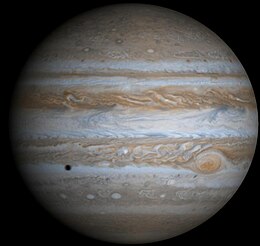
Jupiter at Opposition
| A Cassini image of Jupiter and Europa's shadow. |
(Dec. 3, 2012) The big planet will be at its closest approach to Earth, with it's face fully illuminated by the Sun. If you have a large telescope and camera, there is no better time to view and photograph Jupiter and its many moons.
Switching partners
At the start of December, Saturn and Venus began moving away from each other, until Saturn takes on the waning crescent Moon, as it's new partner. Before daybreak on December 10, Saturn and the moon will partner up and then before the sun rises on Dec. 11, Venus will once again partner up with the Moon.
Shooting stars
Watch from late evening to early morning hours, the Geminid meteor shower (Dec. 4-17), which will peak on the night of Dec. 13-14. At it's best, the Geminids could possibly produce up to 120 meteors per hour and will appear to radiate from the constellation Gemini (thus the name).
*
Sources:
One Minute Astronomer
Jupiter- Wikipedia
Meteor Showers Online
*******************************************************
Sunday, October 14, 2012
Space Jump Live Today- Link to Site
*
Felix Baumgartner has launched and is on his way to space!
Watch here:
http://gizmodo.com/5951563/first-human-supersonic-space-jump-live-coverage
**************************************************
Tuesday, July 31, 2012
"Lay me down gently"- "Sky Crane" Set To Lower Curiosity Down to Mars Surface
*
*
CNET News- The question is straightforward: how to get a car-size rover safely to the surface of Mars? And not just anywhere, but to a very precisely defined bull-s-eye on the floor of a broad crater, within roving distance of a 3-mile-high mountain.
In earlier ventures to Mars, spacecraft have either bounced to the surface cocooned in giant airbags or made the trip atop a rocket-powered descent stage. But neither approach was an option for NASA's Curiosity rover, the centerpiece of the $2.5 billion Mars Science Laboratory mission.
Tipping the scales at one ton, the nuclear-powered Curiosity, a rolling laboratory equipped with a suite of state-of-the-art cameras and instruments, is too massive to use airbags like the ones that cushioned the landings of NASA's much smaller Pathfinder and the hugely successful Spirit and Opportunity rovers.
While a legged lander could do the trick, powerful braking rockets would be needed to get Curiosity to the surface. The sheer size of the descent stage would result in a daunting engineering challenge: get a bulky rover safely down to the surface from a perch many feet above the ground atop its lander.
"This rover is 900 kilograms, it is a beast, it is the size of a car," said Steve Sell, an entry, descent and landing engineer at the Jet Propulsion Laboratory. "So you're trying to land something very heavy, so that means you need sizable engines."
More powerful rocket engines could kick up billowing clouds of dusty debris as the lander approached touchdown "so you tend to want to keep the engines farther away from the surface," Sell said.
"That makes you want to have longer legs, and having longer legs means your center of gravity is higher and then it's much easier to tip over," he said. "Or you need to be very wide. It tends to drive you [to a] larger and larger [lander] in order to do that and be stable."
Then there is the little matter of getting the rover down to the surface after landing.
"Let's say you solved all that and were able to land and you now had to drive a one-ton rover off the top of a platform, either down ramps or some other kind of mechanism," Sell said. "If you were oriented in a way that maybe wasn't favorable to your wheels, like you were tilted to your side, you could slide sideways off the ramps. Maybe there are rocks where the bottoms of the ramps would normally touch and you can't deploy the ramp in the first place."
**************************************************
High-stakes Mars mission relies on untried 'sky crane'
At first blush, using a rocket-powered flying crane to lower a $2.5 billion nuclear-powered rover to the surface of Mars seems risky at best. But engineers say it solves a host of daunting challenges.
The entry, descent and landing of the Mars Science Laboratory requires autonomous steering, a supersonic braking parachute and an innovative "sky crane" technique to lower the nuclear-powered rover to the surface of the red planet. (Credit: NASA) |
*
CNET News- The question is straightforward: how to get a car-size rover safely to the surface of Mars? And not just anywhere, but to a very precisely defined bull-s-eye on the floor of a broad crater, within roving distance of a 3-mile-high mountain.
In earlier ventures to Mars, spacecraft have either bounced to the surface cocooned in giant airbags or made the trip atop a rocket-powered descent stage. But neither approach was an option for NASA's Curiosity rover, the centerpiece of the $2.5 billion Mars Science Laboratory mission.
While a legged lander could do the trick, powerful braking rockets would be needed to get Curiosity to the surface. The sheer size of the descent stage would result in a daunting engineering challenge: get a bulky rover safely down to the surface from a perch many feet above the ground atop its lander.
"This rover is 900 kilograms, it is a beast, it is the size of a car," said Steve Sell, an entry, descent and landing engineer at the Jet Propulsion Laboratory. "So you're trying to land something very heavy, so that means you need sizable engines."
More powerful rocket engines could kick up billowing clouds of dusty debris as the lander approached touchdown "so you tend to want to keep the engines farther away from the surface," Sell said.
"That makes you want to have longer legs, and having longer legs means your center of gravity is higher and then it's much easier to tip over," he said. "Or you need to be very wide. It tends to drive you [to a] larger and larger [lander] in order to do that and be stable."
Then there is the little matter of getting the rover down to the surface after landing.
"Let's say you solved all that and were able to land and you now had to drive a one-ton rover off the top of a platform, either down ramps or some other kind of mechanism," Sell said. "If you were oriented in a way that maybe wasn't favorable to your wheels, like you were tilted to your side, you could slide sideways off the ramps. Maybe there are rocks where the bottoms of the ramps would normally touch and you can't deploy the ramp in the first place."
**************************************************
Wednesday, July 4, 2012
Happy 4th of July!
*

*
We've been busy working several cases, so we're taking a couple of day off to enjoy the holiday with family and friends.
Everyone please have a safe and happy 4th of July!
**************************************************

*
We've been busy working several cases, so we're taking a couple of day off to enjoy the holiday with family and friends.
Everyone please have a safe and happy 4th of July!
-Sunny Williams and the LITS team.
**************************************************
Thursday, May 31, 2012
Once in a Lifetime: Transit of Venus, Tuesday, June 5, 2012
*
*
Transit of Venus: This Tuesday (or 2117)
(May 31, 2012) How far away is the sun? Over a period of several hundred years, the answer to this seemingly simple question was one of the Holy Grails of astronomy, and for good reason: The mean sun-Earth distance, known as the astronomical unit, or AU, is our fundamental datum for the size of the universe. It’s the first step on the “distance ladder,” which allows astronomers to determine how far stars and galaxies are away from us, essentially putting the cosmos into perspective.
After the publication in 1543 of Copernicus’ proof, beyond all reasonable doubt, that the Earth and other planets orbited the sun, nearly two centuries would pass before Johannes Kepler showed that the relative size of a planet’s orbit could be derived from the length of its period around the sun. (This is Kepler’s “third law of planetary motion.”) What was missing was the absolute scale, which comes down to finding the value of the AU, since everything depends on accurately measuring this one critical distance. The great British astronomer Edmund Halley, who lived from 1656 to 1742 — and who correctly predicted the return of his eponymous comet in 1759 — realized that a transit of Venus, when the planet can be seen crossing the sun’s disk, would provide a practical way of determining the AU. This is why next Tuesday’s event is so historically important.
Transits of Venus are rare. They come in a 243-year pattern, with pairs occurring eight years apart that are then separated by 121.5 and 105.5 years. The pattern derives from the resonance between Earth and Venus: 243 Earth orbits equal almost exactly — within 10 hours! — 395 Venus orbits. Following Halley’s insight, astronomers were anxious to take advantage of the 1761/1769 pair of transits to nail down the value of the AU. In particular, the 1769 transit was observed from all over, including Tahiti, Siberia, Calcutta and Cape Town. Averaging out the results established the AU to better than 10 percent of its true value.
Due to parallax, during a transit Venus appears to track along slightly different parallel paths across the face of the sun when observed from, say, Tokyo and Sydney. These paths are very close together — too close to reliably measure how far apart they are. Halley’s trick was to measure the difference in transit time for each observer, from which the AU can be calculated (details at www-spof.gsfc.nasa.gov/stargaze/Svenus1.htm). For instance, during next week’s transit, an observer in Tokyo will see Venus take 6 hours 1 minute 33 seconds to cross the sun from “second contact” (moving inward, just inside sun’s disk) to “third contact” (moving outward, just inside). The equivalent period for an observer in Sydney, Australia, is 9 minutes 15 seconds less, and that’s the key to deriving the AU.
On Tuesday afternoon (June 5), it should be possible to see the disk of Venus, 1/32 of the sun’s diameter, without magnification (at least for youngsters, whose good eyes can resolve to the necessary one minute of arc). The same cautions apply as for the annular eclipse, or for any solar viewing: No naked eyes! No viewing through unfiltered binocs or telescopes! See the sidebar to the May 17 annular eclipse story for tips on safe viewing. “First contact” in Humboldt occurs at about 3:07 p.m. and Venus will still be transiting the sun at sunset. And good luck: If you miss this one, you won’t get another until 2117.
Barry Evans (barryevans9@yahoo.com) pessimistically assumes this may be his last transit of Venus.
News Source: Northcoastjournal.com
*
I have to agree with Mr. Evans assumption, for myself as well.
As for viewing the transit, please use caution and common sense! Do not attempt to view the sun while looking through telescopes or binoculars, with the naked eye, or the naked eye alone! Such methods would seriously damage your eyes and even cause permanent blindness.
[Note: The sun can also damage the sensitive lens of a camera/video cam.]
For six safe ways to see the transit, please go here.
http://www.transitofvenus.org/june2012/eye-safety/281-six-ways-to-see-the-transit-of-venus
Happy, safe viewing of a once-in-a-lifetime event! - Sunny
**************************************************
| Image courtesy Space.com. Read the full story here. |
Transit of Venus: This Tuesday (or 2117)
(May 31, 2012) How far away is the sun? Over a period of several hundred years, the answer to this seemingly simple question was one of the Holy Grails of astronomy, and for good reason: The mean sun-Earth distance, known as the astronomical unit, or AU, is our fundamental datum for the size of the universe. It’s the first step on the “distance ladder,” which allows astronomers to determine how far stars and galaxies are away from us, essentially putting the cosmos into perspective.After the publication in 1543 of Copernicus’ proof, beyond all reasonable doubt, that the Earth and other planets orbited the sun, nearly two centuries would pass before Johannes Kepler showed that the relative size of a planet’s orbit could be derived from the length of its period around the sun. (This is Kepler’s “third law of planetary motion.”) What was missing was the absolute scale, which comes down to finding the value of the AU, since everything depends on accurately measuring this one critical distance. The great British astronomer Edmund Halley, who lived from 1656 to 1742 — and who correctly predicted the return of his eponymous comet in 1759 — realized that a transit of Venus, when the planet can be seen crossing the sun’s disk, would provide a practical way of determining the AU. This is why next Tuesday’s event is so historically important.
| Venus just after “second contact,” beginning its June 8, 2004 transit across the face of the sun. JAN HEROLD, WIKIMEDIA COMMONS |
Due to parallax, during a transit Venus appears to track along slightly different parallel paths across the face of the sun when observed from, say, Tokyo and Sydney. These paths are very close together — too close to reliably measure how far apart they are. Halley’s trick was to measure the difference in transit time for each observer, from which the AU can be calculated (details at www-spof.gsfc.nasa.gov/stargaze/Svenus1.htm). For instance, during next week’s transit, an observer in Tokyo will see Venus take 6 hours 1 minute 33 seconds to cross the sun from “second contact” (moving inward, just inside sun’s disk) to “third contact” (moving outward, just inside). The equivalent period for an observer in Sydney, Australia, is 9 minutes 15 seconds less, and that’s the key to deriving the AU.
On Tuesday afternoon (June 5), it should be possible to see the disk of Venus, 1/32 of the sun’s diameter, without magnification (at least for youngsters, whose good eyes can resolve to the necessary one minute of arc). The same cautions apply as for the annular eclipse, or for any solar viewing: No naked eyes! No viewing through unfiltered binocs or telescopes! See the sidebar to the May 17 annular eclipse story for tips on safe viewing. “First contact” in Humboldt occurs at about 3:07 p.m. and Venus will still be transiting the sun at sunset. And good luck: If you miss this one, you won’t get another until 2117.
Barry Evans (barryevans9@yahoo.com) pessimistically assumes this may be his last transit of Venus.
News Source: Northcoastjournal.com
*
I have to agree with Mr. Evans assumption, for myself as well.
| Click image for larger view. Image courtesy NASA and Canada.com |
[Note: The sun can also damage the sensitive lens of a camera/video cam.]
For six safe ways to see the transit, please go here.
http://www.transitofvenus.org/june2012/eye-safety/281-six-ways-to-see-the-transit-of-venus
Happy, safe viewing of a once-in-a-lifetime event! - Sunny
**************************************************
Thursday, May 17, 2012
Texas Panhandle Residents To See "Ring of Fire" Solar Eclipse, May 20, 2012
*
Jan. 4, 2011- The joint Japanese-American Hinode satellite captured a breathtaking event from space. The unique view created what's called an annular solar eclipse. CREDIT: Hinode/XRT |
On Sunday afternoon (May 20), the path of an annular solar eclipse will cross parts of eight western states. SPACE.com estimates that an estimated 6.6 million Americans live within the path of annularity.
An annular solar eclipse is typically no match for a total solar eclipse. It is really more like an embellished partial eclipse, with the beautiful solar corona not becoming visible and the sky never getting really dark. Nevertheless, an annular solar eclipse still ranks as one of the most remarkable of celestial sights for avid skywatchers.
Sunday's eclipse track begins in East Asia and crossed the Pacific Ocean before reaching North America. In the United States, the U.S. National Park Service has invited skywatchers to view the solar eclipse from a national park, while the University of Colorado, at Boulder is opening its Folsom Stadium — a football stadium — to the public in what organizers are calling the world's largest solar eclipse viewing party.
*
*
Lubbock, Texas, is not on center line, but is about 25 miles to the northeast. From there, an almost perfect ring will be formed, lasting 4 minutes 14 seconds beginning at 8:33:54 p.m. CDT. But the sun will be only 1.3 degrees above the horizon when the annular eclipse begins.
Annularity will end six minutes before sunset. Farther to the southeast, the effect of atmospheric refraction must be taken into account. The thick atmosphere at the horizon refracts or bends sunlight so that we are seeing the setting sun about a half degree above where it really is.
In Snyder, Texas, for example, calculations neglecting refraction suggest that only the beginning of the 3 minute 40 second ring phase (at 8:33:43 p.m. CDT) will be visible before the sun drops below the horizon, but taking refraction into account shows that the sun will remain above the horizon for another nine minutes. At Sweetwater, Texas, the sun will resemble a horseshoe with narrow, pointed tips tilted down and to the right when it transitions to a lopsided ring at 8:34:27 p.m. CDT. Less than three minutes later, the sun will set.
Read the full story on Space.com
Video of where to see May 20, 2012 solar eclipse
How to safely photograph the "Ring of Fire:
Note: Take precautions when photographing the sun, even during an eclipse. Please check out the link above, for tips on safely photographing the eclipse.
If you would like to send in your photos of the "Ring of Fire", I will be happy to post them here on Lights in the Texas Sky.
**************************************************
Thursday, March 15, 2012
Venus and Jupiter Put On Dazzling Display In Mid March, 2012
*

*
Those aren't unidentified flying objects (UFOs) in the sky, those are our neighboring planets!
Aside from a waning moon, Venus and Jupiter are the brightest lights in our skies right now and they are putting on a spectacular show.
Best Venus-Jupiter conjunction in years in mid-March 2012

*
Those aren't unidentified flying objects (UFOs) in the sky, those are our neighboring planets!
Aside from a waning moon, Venus and Jupiter are the brightest lights in our skies right now and they are putting on a spectacular show.
Best Venus-Jupiter conjunction in years in mid-March 2012
The whole world can see the two bright lights in the west after sunset now, but, for the Northern Hemisphere, mid-March 2012 presents the best time to see a Venus-Jupiter conjunction in the evening for years to come. At mid-northern latitudes, these two brightest planets – Venus and Jupiter – stay out for nearly four hours after sunset. That’s about the longest period possible at these latitudes. No matter where you are on Earth now, you can’t miss these two worlds in the west as darkness falls.
And in the opposite direction at nightfall – looking east – you can’t miss the ruddy planet Mars. This world won’t be so brilliant in our sky again until April 2014. Mars shines from dusk till dawn, whereas Venus and Mars set four hours after sunset at mid-northern latitudes.
How to see Mars in March 2012
March 15, 2012 presents the exact date of conjunction, when these two worlds have the same right ascension (like longitude on Earth) in Earth’s sky. But Venus and Jupiter are close throughout the month of March 2012. They are like twin beacons – two very bright planets – near each other in the west as soon as the sun goes down.
The next Venus-Jupiter conjunction after this one falls on May 28, 2013. Although Venus and Jupiter will be closer together on the sky’s dome during that conjunction, they won’t be as spectacular then as they are this month. That’s because, in May 2013, the two planets will set only a little more than one hour after the sun (at mid-northern latitudes).
Why are Venus and Jupiter up so long after sunset now? For any Venus-Jupiter conjunction to light up the nighttime for a maximum time after dark, a perfect storm of conditions has to prevail. First of all, Venus has to be at or near its greatest evening elongation – farthest angular distance from the setting sun. Second, the ecliptic – or pathway of the planets – has to make its steepest angle with the sunset horizon. Both of these conditions exist this month. The greatest elongation for Venus – when this planet is due to be farthest from the sunset – will happen on March 27, 2012. As for the angle of the ecliptic, it could not be more ideal than March for evening viewing, as seen from the Northern Hemisphere.
The close coincidence of Venus and Jupiter in conjunction, the steep angle of the ecliptic and Venus’ greatest evening elongation keeps these worlds up for several hours after dark – and ensures the Northern Hemisphere of a beautiful gathering of worlds in the western evening sky this month. They are well worth getting outside to see.
Bottom line: Venus and Jupiter are in conjunction on March 15, 2012. This is the best evening Venus-Jupiter conjunction for years, as seen from the Northern Hemisphere. Venus and Jupiter stay out for nearly four hours after sunset. Venus and Jupiter are close throughout the month of March 2012. They are like twin beacons – two very bright planets – near each other in the west as soon as the sun goes down.
Source: EarthSky.org
**************************************************
Monday, January 2, 2012
Top 12 List: 2012 Sky Watching Events
*
CSMonitor.com- What lies ahead sky-wise for 2012? What celestial events might we look forward to seeing?
Joe Rao, SPACE.com Skywatching Columnist, selected what he considers to be the top 12 "skylights" for this coming year, and list them in chronological order. Not all these events will be visible from any one locality … for the eclipses, for instance, you'll probably have to do some traveling … but many can be observed from the comfort of your backyard.
And you won't have to wait long for the action to begin. On Jan. 4, the Quadrantid meteor shower will peak with an estimated 100 meteors per hour, according to NASA.
Hopefully your local weather will cooperate on most, if not all, of these dates. Clear skies!
- Joe Rao
1. Quadrantid meteor shower (January 4, 2012)
This meteor shower reaches its peak in the predawn hours of Jan. 4 for eastern North America. The Quadrantid meteor shower is a very short-lived meteor display, whose peak rates only last several hours. The phase of the moon is a bright waxing gibbous, normally prohibitive for viewing any meteor shower, but the moon will set by 3 a.m., leaving the sky dark for a few hours until the first light of dawn; that's when you'll have the best shot at seeing many of these bluish-hued meteors.
From the eastern half of North America, a single observer might count on seeing as many as 50-to-100 "Quads" in a single hour. From the western half of the continent the display will be on the wane by the time the moon sets, with hourly rates probably diminishing to around 25 to 50 meteors.
2. Feb. 20 to March 12: Best evening apparition of Mercury
In February and March, the "elusive" innermost planet Mercury moves far enough from the glare of the sun to be readily visible soon after sunset. Its appearance will be augmented by two other bright planets (Venus and Jupiter), which also will be visible in the western sky during this same time frame.
Mercury will arrive at its greatest elongation from the sun March 5. It will be quite bright (-1.3-to-0 magnitude) before this date and will fade rapidly to +1.6 magnitude thereafter. Astronomers measure the brightness of objects in terms of magnitude, with lower numbers corresponding to brighter objects.
3. March 3: Mars arrives at opposition
On March 3, the Earth will be passing Mars as the two planets wheel around the sun in their respective orbits. Because Mars reaches aphelion — its farthest point from the sun — on Feb. 15, this particular opposition will be an unfavorable one. In fact, two days after opposition, Mars will be closest to Earth at a distance of 62.6 million miles.
Compare this with the August 2003 opposition when Mars was only 34.6 million miles away. Nonetheless, even at this unfavorable opposition the fiery-hued Mars will be an imposing naked-eye sight, shining at magnitude -1.2, just a bit dimmer than Sirius, the brightest star, and will be visible in the sky all night long.
4. March 13: Brilliant "double planet"
The two brightest planets, Venus and Jupiter, team up to make for an eye-catching sight in the western sky soon after sunset. They will be separated by 3 degrees on this evening, Venus passing to the northwest (upper right) of Jupiter and shining nearly eight times brighter than "Big Jupe." Although they will gradually go their separate ways after this date, on March 25 and 26, a crescent moon will pass by, adding additional beauty to this celestial scene.
5. May 5: Biggest full moon of 2012
The moon turns full at 11:35 p.m. Eastern Daylight Time and just 25 minutes later it will arrive at its closest point to the Earth in 2012, at a distance of 221,801 miles. Expect a large range in ocean tides (exceptionally low to exceptionally high) for the next few days
6. May 20: Annular eclipse of the sun
The path of annularity for this eclipse starts over eastern China and sweeps northeast across southern and central Japan. The path continues northeast then east, passing just south of Alaska's Aleutian Island chain. The path then turns to the southeast, making landfall in the western United States along the California-Oregon coast. It will pass over central Nevada, southern Utah, northern Arizona, the extreme southwest corner of Colorado and most of New Mexico before coming to an end over northern Texas.
Since the disk of the moon will appear smaller than the disk of the sun, it will create a "penny on nickel" effect, with a fiery ring of sunlight shining around the moon's dark silhouette. Locations that will witness this eerie sight include Eureka and Reading, Calif.; Carson City, Reno and Ely, Nev.; Bryce Canyon in Utah; Arizona's Grand Canyon; Albuquerque and Santa Fe in New Mexico and just prior to sunset for Lubbock, Tex.
A partial eclipse of the sun will be visible over a large swath of the United States and Canada, including Alaska and Hawaii, but no eclipse will be visible near and along the Atlantic Seaboard.
7. June 4: Partial eclipse of the moon
This partial lunar eclipse favors the Pacific Ocean; Hawaii sees it high in the sky during the middle of its night. Across North America the eclipse takes place between midnight and dawn. The farther east one goes, the closer the time of moonset coincides with the moment that the moon enters the Earth's dark umbral shadow.
In fact, over the Northeastern United States and eastern Canada, the only evidence of this eclipse will be a slight shading on the moon's left edge (the faint penumbral shadow) before moonset. Over the Canadian Maritimes, the moon will set before the eclipse begins. At maximum, more than one-third of the moon's lower portion (37.6-percent) will be immersed in the umbra.
8. June 5: Rare transit of Venus across the sun
The passage of Venus in front of the sun is among the rarest of astronomical events, rarer even than the return of Halley's Comet every 76 years. Only six transits of Venus are known to have been observed by humans before: in 1639, 1761, 1769, 1874, 1882 and, most recently, in 2004.
The next one will occur in the year 2117. When Venus is in transit across the solar disk, the planet appears as a distinct, albeit tiny, round black spot with a diameter just 1/32nd of the sun. This size is large enough to readily perceive with the naked eye. HOWEVER ... prospective observers are warned to take special precautions (as with a solar eclipse) when attempting to view the silhouette of Venus against the blindingly brilliant solar disc.
The beginning of the transit will be visible from all of North America, Greenland, extreme northern and western portions of South America, Hawaii, northern and eastern portions of Asia including Japan, New Guinea, northern and eastern portions of Australia, and New Zealand. The end will be visible over Alaska, all of Asia and Indonesia, Australia, Eastern Europe, the eastern third of Africa, and the island nation of Madagascar.
9. Aug. 12: Perseid meteor shower
Considered to be among the best of the annual displays thanks to its high rates of up to 90 per hour for a single observer, as well as its reliability. Beloved by summer campers and often discovered by city dwellers who might be spending time in the country under dark starry skies.
Last summer a bright moon wrecked the shower by blotting out many of the fainter streaks, but in 2012 the moon will be three days past last quarter phase on this peak morning – a fat waning crescent presenting only a minor nuisance for prospective observers.
10. Nov. 13: Total eclipse of the sun
The first total solar eclipse since July 2010. Virtually the entire path of totality falls over water. At the very beginning, the track cuts through Australia's Northern Territory just to the east of Darwin, then across the Gulf of Carpentaria, then through northern Queensland, passing over Cairns and Port Douglas before heading out to sea.
The rest of the eclipse path, including the point of the maximum duration of totality (4 minutes, 2 seconds) is, unfortunately, pretty much wasted by falling over the open waters of the Pacific Ocean.
11. Dec. 13-14: Geminid meteor shower
If there is one meteor display guaranteed to put on a very entertaining show it is the Geminid meteor shower. Now considered by most meteor experts to be at the top of the list, surpassing in brilliance and reliability even the August Perseids.
Bundle warmly against the winter chill; you can start observing as soon as darkness falls on the evening of Dec. 13 as Gemini starts coming up above the eastern horizon and continue through the rest of the night. Around 2 a.m. when Gemini is almost directly overhead, you might see as many as two meteor sightings per minute … 120 per hour! And the moon is new, meaning that it will not be a factor at all.
12. Dec. 25: Christmas evening and Jupiter
On Christmas, many will be looking skyward and wondering what that brilliant silvery "star" is hovering just above the waxing gibbous moon. It's not a star (or Santa returning to the North Pole), but the largest planet in our solar system, Jupiter, serving as a sort of holiday ornament with our nearest neighbor in space to cap off a year of interesting and predictable sky events that we all can enjoy!
More...
* Special thanks to - Joe Rao , Space.com and the Christian Science Monitor.
** Joe Rao serves as an instructor and guest lecturer at New York's Hayden Planetarium. He writes about astronomy for The New York Times and other publications, and he is also an on-camera meteorologist for News 12 Westchester, New York.
**************************************************

Quadrantid meteors and 11 other big skywatching events of 2012
CSMonitor.com- What lies ahead sky-wise for 2012? What celestial events might we look forward to seeing?
Joe Rao, SPACE.com Skywatching Columnist, selected what he considers to be the top 12 "skylights" for this coming year, and list them in chronological order. Not all these events will be visible from any one locality … for the eclipses, for instance, you'll probably have to do some traveling … but many can be observed from the comfort of your backyard.
And you won't have to wait long for the action to begin. On Jan. 4, the Quadrantid meteor shower will peak with an estimated 100 meteors per hour, according to NASA.
Hopefully your local weather will cooperate on most, if not all, of these dates. Clear skies!
- Joe Rao
1. Quadrantid meteor shower (January 4, 2012)
This meteor shower reaches its peak in the predawn hours of Jan. 4 for eastern North America. The Quadrantid meteor shower is a very short-lived meteor display, whose peak rates only last several hours. The phase of the moon is a bright waxing gibbous, normally prohibitive for viewing any meteor shower, but the moon will set by 3 a.m., leaving the sky dark for a few hours until the first light of dawn; that's when you'll have the best shot at seeing many of these bluish-hued meteors.
From the eastern half of North America, a single observer might count on seeing as many as 50-to-100 "Quads" in a single hour. From the western half of the continent the display will be on the wane by the time the moon sets, with hourly rates probably diminishing to around 25 to 50 meteors.
2. Feb. 20 to March 12: Best evening apparition of Mercury
In February and March, the "elusive" innermost planet Mercury moves far enough from the glare of the sun to be readily visible soon after sunset. Its appearance will be augmented by two other bright planets (Venus and Jupiter), which also will be visible in the western sky during this same time frame.
Mercury will arrive at its greatest elongation from the sun March 5. It will be quite bright (-1.3-to-0 magnitude) before this date and will fade rapidly to +1.6 magnitude thereafter. Astronomers measure the brightness of objects in terms of magnitude, with lower numbers corresponding to brighter objects.
3. March 3: Mars arrives at opposition
On March 3, the Earth will be passing Mars as the two planets wheel around the sun in their respective orbits. Because Mars reaches aphelion — its farthest point from the sun — on Feb. 15, this particular opposition will be an unfavorable one. In fact, two days after opposition, Mars will be closest to Earth at a distance of 62.6 million miles.
Compare this with the August 2003 opposition when Mars was only 34.6 million miles away. Nonetheless, even at this unfavorable opposition the fiery-hued Mars will be an imposing naked-eye sight, shining at magnitude -1.2, just a bit dimmer than Sirius, the brightest star, and will be visible in the sky all night long.
4. March 13: Brilliant "double planet"
The two brightest planets, Venus and Jupiter, team up to make for an eye-catching sight in the western sky soon after sunset. They will be separated by 3 degrees on this evening, Venus passing to the northwest (upper right) of Jupiter and shining nearly eight times brighter than "Big Jupe." Although they will gradually go their separate ways after this date, on March 25 and 26, a crescent moon will pass by, adding additional beauty to this celestial scene.
5. May 5: Biggest full moon of 2012
The moon turns full at 11:35 p.m. Eastern Daylight Time and just 25 minutes later it will arrive at its closest point to the Earth in 2012, at a distance of 221,801 miles. Expect a large range in ocean tides (exceptionally low to exceptionally high) for the next few days
6. May 20: Annular eclipse of the sun
The path of annularity for this eclipse starts over eastern China and sweeps northeast across southern and central Japan. The path continues northeast then east, passing just south of Alaska's Aleutian Island chain. The path then turns to the southeast, making landfall in the western United States along the California-Oregon coast. It will pass over central Nevada, southern Utah, northern Arizona, the extreme southwest corner of Colorado and most of New Mexico before coming to an end over northern Texas.
Since the disk of the moon will appear smaller than the disk of the sun, it will create a "penny on nickel" effect, with a fiery ring of sunlight shining around the moon's dark silhouette. Locations that will witness this eerie sight include Eureka and Reading, Calif.; Carson City, Reno and Ely, Nev.; Bryce Canyon in Utah; Arizona's Grand Canyon; Albuquerque and Santa Fe in New Mexico and just prior to sunset for Lubbock, Tex.
A partial eclipse of the sun will be visible over a large swath of the United States and Canada, including Alaska and Hawaii, but no eclipse will be visible near and along the Atlantic Seaboard.
7. June 4: Partial eclipse of the moon
This partial lunar eclipse favors the Pacific Ocean; Hawaii sees it high in the sky during the middle of its night. Across North America the eclipse takes place between midnight and dawn. The farther east one goes, the closer the time of moonset coincides with the moment that the moon enters the Earth's dark umbral shadow.
In fact, over the Northeastern United States and eastern Canada, the only evidence of this eclipse will be a slight shading on the moon's left edge (the faint penumbral shadow) before moonset. Over the Canadian Maritimes, the moon will set before the eclipse begins. At maximum, more than one-third of the moon's lower portion (37.6-percent) will be immersed in the umbra.
8. June 5: Rare transit of Venus across the sun
The passage of Venus in front of the sun is among the rarest of astronomical events, rarer even than the return of Halley's Comet every 76 years. Only six transits of Venus are known to have been observed by humans before: in 1639, 1761, 1769, 1874, 1882 and, most recently, in 2004.
The next one will occur in the year 2117. When Venus is in transit across the solar disk, the planet appears as a distinct, albeit tiny, round black spot with a diameter just 1/32nd of the sun. This size is large enough to readily perceive with the naked eye. HOWEVER ... prospective observers are warned to take special precautions (as with a solar eclipse) when attempting to view the silhouette of Venus against the blindingly brilliant solar disc.
The beginning of the transit will be visible from all of North America, Greenland, extreme northern and western portions of South America, Hawaii, northern and eastern portions of Asia including Japan, New Guinea, northern and eastern portions of Australia, and New Zealand. The end will be visible over Alaska, all of Asia and Indonesia, Australia, Eastern Europe, the eastern third of Africa, and the island nation of Madagascar.
9. Aug. 12: Perseid meteor shower
Considered to be among the best of the annual displays thanks to its high rates of up to 90 per hour for a single observer, as well as its reliability. Beloved by summer campers and often discovered by city dwellers who might be spending time in the country under dark starry skies.
Last summer a bright moon wrecked the shower by blotting out many of the fainter streaks, but in 2012 the moon will be three days past last quarter phase on this peak morning – a fat waning crescent presenting only a minor nuisance for prospective observers.
10. Nov. 13: Total eclipse of the sun
The first total solar eclipse since July 2010. Virtually the entire path of totality falls over water. At the very beginning, the track cuts through Australia's Northern Territory just to the east of Darwin, then across the Gulf of Carpentaria, then through northern Queensland, passing over Cairns and Port Douglas before heading out to sea.
The rest of the eclipse path, including the point of the maximum duration of totality (4 minutes, 2 seconds) is, unfortunately, pretty much wasted by falling over the open waters of the Pacific Ocean.
11. Dec. 13-14: Geminid meteor shower
If there is one meteor display guaranteed to put on a very entertaining show it is the Geminid meteor shower. Now considered by most meteor experts to be at the top of the list, surpassing in brilliance and reliability even the August Perseids.
Bundle warmly against the winter chill; you can start observing as soon as darkness falls on the evening of Dec. 13 as Gemini starts coming up above the eastern horizon and continue through the rest of the night. Around 2 a.m. when Gemini is almost directly overhead, you might see as many as two meteor sightings per minute … 120 per hour! And the moon is new, meaning that it will not be a factor at all.
12. Dec. 25: Christmas evening and Jupiter
On Christmas, many will be looking skyward and wondering what that brilliant silvery "star" is hovering just above the waxing gibbous moon. It's not a star (or Santa returning to the North Pole), but the largest planet in our solar system, Jupiter, serving as a sort of holiday ornament with our nearest neighbor in space to cap off a year of interesting and predictable sky events that we all can enjoy!
More...
* Special thanks to - Joe Rao , Space.com and the Christian Science Monitor.
** Joe Rao serves as an instructor and guest lecturer at New York's Hayden Planetarium. He writes about astronomy for The New York Times and other publications, and he is also an on-camera meteorologist for News 12 Westchester, New York.
**************************************************
Subscribe to:
Posts (Atom)